
Noticias

North Korea’s Han Kwang-song Returns to International Soccer

North Korea’s Han Kwang-song Returns to International Soccer

Advertisement
SKIP ADVERTISEMENT
You have a preview view of this article while we are checking your access. When we have confirmed access, the full article content will load.
When the North Korean men’s soccer team took the field for two 2026 World Cup qualifying matches this month, close observers noticed an important roster change.
Han Kwang-song, a high-profile striker, was back, more than three years after vanishing from public view for reasons beyond his control: United Nations-imposed sanctions on North Korean nationals over Pyongyang’s nuclear program.
Mr. Han’s story is a rare case of North Korea sanctions reverberating through professional soccer. It also shows how enforcement of U.N. sanctions against individuals varies by country.
The government in Italy did not deport Mr. Han, now 25, while he was playing professional soccer there. But once he moved to Qatar, the Qatari government did.
“The basic story makes sense; the surprising part is that Qatar complied with the U.N. resolutions,” said Marcus Noland, an expert on North Korean sanctions and executive vice president of the Peterson Institute for International Economics in Washington.
A prodigy with ‘superhero’ status
Mr. Han’s early success was partly a product of North Korea’s push to cultivate soccer talent. After attending a prestigious soccer school founded by the country’s leader, Kim Jong-un, Mr. Han trained in Spain before turning pro in Italy.
Thank you for your patience while we verify access. If you are in Reader mode please exit and
log into
your Times account, or
subscribe
for all of The Times.
Thank you for your patience while we verify access.
Already a subscriber?
Log in
.
Want all of The Times?
Subscribe
.
Related Content
Advertisement
SKIP ADVERTISEMENT

Swedish Soccer Prioritized Fans Over Finances. Now, Business Is Booming.

Swedish Soccer Prioritized Fans Over Finances. Now, Business Is Booming.

Advertisement
SKIP ADVERTISEMENT
You have a preview view of this article while we are checking your access. When we have confirmed access, the full article content will load.
The warning sounded over and over, first in Swedish and then in English. A fire had been detected. Please evacuate the stadium. The players left the field. Outside, fire crews were arriving. But in the stands, as a thick cloud of smoke wreathed and coiled in the floodlights, nobody moved. The fans were going to make the game happen by sheer force of will.
It was a game they had been anticipating for some time. The top two teams in the Allsvenskan, Sweden’s elite league, had gone into the final day of the season separated by just three points. A quirk of scheduling fate meant that their last game was with each other. Malmo, the host, had to win to claim the championship. Elfsborg, the visitor, needed only to avoid defeat. It had been billed as a
guldfinal
: a gold-medal match.
The idea of a single game that decides the destiny of a league title is vanishingly rare in modern soccer, where championships are won over the course of a season rather than in a winner-take-all final. It has not happened in England since 1989, and Italy has not produced such a denouement in more than half a century.
Image
Fans of Malmo, left, and Elfsborg. The teams met to decide the Swedish league title on the final day of the season.
Credit…
Betina Garcia for The New York Times
Image
“It might not be the best league in Europe,” the league’s chief executive said, “but the atmosphere in the stands is.”
Credit…
Betina Garcia for The New York Times
It is also increasingly unusual for a title even to be in play as the season draws to a close. Over the last 30 years, soccer has become so financially stratified that many domestic tournaments are little more than
monthslong processions
for the wealthiest teams. Sweden, though, is different, a solitary beacon of competitive balance. In four of the last six editions of the Allsvenskan, the championship has gone to the wire.
How it has produced that is a story of rejecting orthodoxy, of asking why sports exist and whom they exist for. But it is also a story of how hard it is to stand alone, and how fragile even the most heartening success can be.
Thank you for your patience while we verify access. If you are in Reader mode please exit and
log into
your Times account, or
subscribe
for all of The Times.
Thank you for your patience while we verify access.
Already a subscriber?
Log in
.
Want all of The Times?
Subscribe
.
Related Content
Advertisement
SKIP ADVERTISEMENT

Messi Surcharge: Red Bulls, Other M.L.S. Teams to Charge More for Miami Games

Messi Surcharge: Red Bulls, Other M.L.S. Teams to Charge More for Miami Games

Advertisement
SKIP ADVERTISEMENT
You have a preview view of this article while we are checking your access. When we have confirmed access, the full article content will load.
A
holiday deal
offered by the Red Bulls soccer team includes some merchandise, like a travel mug, as well as tickets to two games, including its first home game.
But there is some fine print. The Major League Soccer schedule will not be announced until the end of the year, and if it turns out that the home opener is against Inter Miami, fans who buy the package will get tickets for the second home game instead.
The reason is Lionel Messi.
Miami is the team of Messi, the global superstar, and a chance to see him is a lot more appealing than a random game against, say, Toronto F.C. Any time he comes to town will be an event, and teams don’t want to just throw such a golden ticket into a package deal.
Some Red Bulls fans who noticed the fine print were annoyed and
expressed
that on social media — words like “gouge” were common. But at least a few others
shrugged it off
as a smart business move. “It’s purely naïve to expect the league not to try to capitalize on this at all costs,” said Dan Rodriguez, a Red Bulls fan from Westchester County, N.Y.
The Red Bulls did not respond to a question about the ticket offer. Even if fans lose the Messi game, the deal still includes a game against the team’s regional rival, N.Y.C.F.C. And because there are 29 M.L.S. teams, the chance that the first game will actually be against Miami and Messi is slim.
Around the league, though, teams are seeing a gold mine in Messi. Not every team has set its full pricing yet, especially since the schedule has not been announced. But the Columbus Crew
is charging
at least $382 for its home game against Miami and $421 and $679 for better seats. In contrast, tickets for ordinary Crew games this year could be had for as little as $40, or less as part of a season ticket package.
Thank you for your patience while we verify access. If you are in Reader mode please exit and
log into
your Times account, or
subscribe
for all of The Times.
Thank you for your patience while we verify access.
Already a subscriber?
Log in
.
Want all of The Times?
Subscribe
.
Related Content
Advertisement
SKIP ADVERTISEMENT
The Premier League Needs a Commissioner

The Premier League Needs a Commissioner

Advertisement
SKIP ADVERTISEMENT
You have a preview view of this article while we are checking your access. When we have confirmed access, the full article content will load.
Pete Rozelle’s immediate reaction could not accurately be described as unbridled enthusiasm. He was 33. He had, for the last three years, been the general manager of the Los Angeles Rams. He was suave, charming and well liked. But he was nevertheless starting to wonder whether running an N.F.L. football team was really the job for him.
And then, outside the Kenilworth Hotel in Miami in January 1960, he was cornered by a cadre of the league’s most fearsome power brokers: the Mara brothers, Jack and Wellington, owners of the Giants; Dan Reeves, the Rams’ benefactor; and Paul Brown, the coach and founder and all-purpose potentate of the team in Cleveland that still bears his name.
They had an offer to make Rozelle. They did not want him to run a franchise. They wanted to put him in charge of the whole league.
It was an offer, in Rozelle’s mind, that he had to refuse. “You’ve got to be kidding,” he told them, according to Michael MacCambridge’s magisterial history of the league, “America’s Game.” “That is the most ludicrous thing I have ever heard.”
Rozelle’s logic was simple. The job of N.F.L. commissioner looked an awful lot like a poisoned chalice. The league’s various owners were split on almost every issue imaginable — not only on who should be commissioner, but also whether to add another slate of expansion teams, whether to sign a collective television deal and how to stave off the threat of the rival American Football League.
There was even contention over where, exactly, the league’s offices should be. Rozelle was not the only one who might have looked at the job description and decided he would have to be a fool, or a madman, to accept.
Thank you for your patience while we verify access. If you are in Reader mode please exit and
log into
your Times account, or
subscribe
for all of The Times.
Thank you for your patience while we verify access.
Already a subscriber?
Log in
.
Want all of The Times?
Subscribe
.
Advertisement
SKIP ADVERTISEMENT

Soccer Watchalongs Like Stretford Paddock Offer a Broadcast Alternative

Soccer Watchalongs Like Stretford Paddock Offer a Broadcast Alternative

Advertisement
SKIP ADVERTISEMENT
You have a preview view of this article while we are checking your access. When we have confirmed access, the full article content will load.
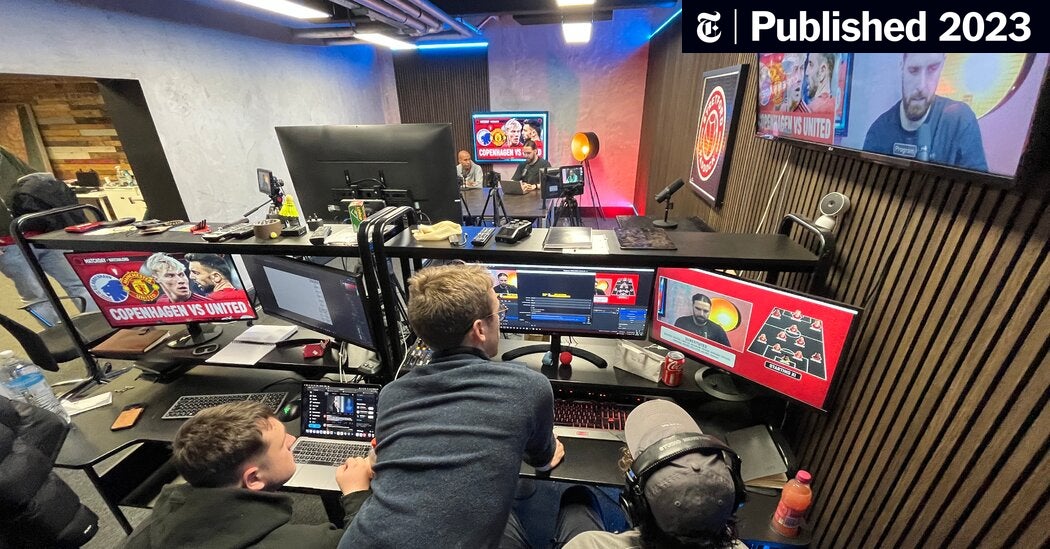
With the lights adjusted and the cameras rolling, the production team gives Joe Smith his cue. In five seconds, he will be broadcasting live to a couple thousand people. Mr. Smith’s mind, though, is elsewhere. “Slate is definitely the best way to build a roof,” he mutters to his co-host, Jay Mottershead, as the countdown hits three. “All these years on, they haven’t topped it.”
And with that, they are on air. They will remain so for the next four hours, essentially uninterrupted: a broadcasting endurance test staged in a subterranean studio, all exposed brick and industrial lighting, in the middle of Manchester’s achingly hip Northern Quarter.
Before they have finished, they will have touched on subjects as diverse as: the slightly alarming frequency with which Mr. Mottershead has nightmares; the declining popularity of lemon curd; and the story of a man who attends Mr. Smith’s gym exclusively to read vintage copies of “Cars” magazine.
Occasionally, their freewheeling, faintly anarchic conversation to be interrupted by what is supposedly the purpose of the evening’s activity: keeping track of the game between the soccer team they support, Manchester United, and the Danish champion, F.C. Copenhagen.
That is, after all, what will attract more than 100,000 people to their livestream over the course of those four hours. It is the diversions and the tangents and the stream of consciousness about roofing, though, that will keep them there.
Image
Watchalongs like Stretford Paddock’s have become big business, with full-scale production crews and hundreds of thousands of subscribers.
Credit…
Rory Smith/The New York Times
Thank you for your patience while we verify access. If you are in Reader mode please exit and
log into
your Times account, or
subscribe
for all of The Times.
Thank you for your patience while we verify access.
Already a subscriber?
Log in
.
Want all of The Times?
Subscribe
.
Related Content
Advertisement
SKIP ADVERTISEMENT

Sigh: An unfortunate experiment

Sigh: An unfortunate experiment

I won’t need to start working on Gold Open Access 2026 until November, but I was wondering whether it would be feasible to switch from MS Office 2019 (which is, after all, a tad out of date) to snazzy up-to-date free/open software LibreOffice 25.
Here’s my experience, and it’s not terribly meaningful because:
I’d be comparing a current LibreOffice to a six-year-old Office.
The GOA project relies heavily on being an annual update, including preparing the books.
I’m old–just reached 80–and perhaps less flexible or  patient than I should be.
Anyway…
Installing LibreOffice
Easy-peasy.
Updating a copy of the primary spreadsheets (saved as LibreOffice Calc sheets)
LibreOffice loads the Excel sheets (most with multiple pages) neatly and saves them properly.
Downloading the DOAJ sheet and opening directly in LibreOffice went very well–actually better than Excel2019, because LibreOffice Calc could handle the Unicode directly on opening, not by going through a special step. (I wouldn’t be surprised if Excel had now fixed this inability to load UTF8 directly in later versions.)
Opening and saving is clearly slower–but not so much slower as to be a killer.
Sorting worked fine.
Vlookup involved a slightly different syntax for referring to a separate named sheet, but the help is excellent, and it worked fine (if differently) after I got the syntax right.
Pivot tables worked slightly differently and in some ways better, although forcing an extra row in one case.
At this point, including preparing new tables for the first three chapters of the book, I was ready to call the experiment a success.
But then…
Copying table contents from spreadsheet to document did NOT work well.
I opened the 2025 book (Gold Open Access 10) and saved a new version, again saved as a LibreOffice document.
To prepare the new book, I update dozens (hundreds?) of tables and modify the relatively small amount of text around them.
Copying all or part of an Excel table and pasting it into the comparable part of a Word table is a snap (once you make sure you’re doing it right).
Doing the same in LibreOffice…well, I don’t think I ever did get it to work properly. Either it would try to paste the entire new set of cells into the first cell of the Word table I’d highlighted, or various “paste special” options would result in various other unacceptable situations. Deleting the existing table and trying to paste in a new table from the set of cells marked in Calc worked……not much better. I believe I was able to get one table right after a certain amount of swearing. The second try was even worse: I gave up. (It also seems to be much slower–and if you try to paste in a way it doesn’t like, it tends to go nuts for a minute or so and then drop back to the start of the document. This behavior does not encourage further experimentation.)
Conclusion: Not yet, if I can avoid it.
If Office 2019 becomes unworkable over the next year, I’ll try buying the current (…

An update to “Sigh”

An update to “Sigh”

When I posted
this
, I had just given up after an extremely frustrating set of attempts to replace the contents of some tables–copying a set of rows and columns in Calc, highlighting the same number of rows and columns in a Writer table, and pasting. What I concluded after too much time and effort was that the pieces of LibreOffice–or at least those two pieces–don’t play well together, or at least not well enough for my Gold OA/Diamond OA project, where preparing the new edition’s books requires copying-and-pasting from the spreadsheets to the documents several hundred times (I’m guessing more than a thousand in all, but definitely quite a few hundred).
A few days later, calmed down and all that, I’ll add a few words–but I don’t plan to try again. Or, rather, I did try one aspect that I hadn’t tried before, with discouraging results.
Calc: The issues encountered
Reasonably trivial: the syntax for Vlookup is slightly different. (The set of options is considerably different–and confusingly so–but it’s possible that Excel 2024 would be more similar.)
Less trivial but I could probably live with it: opening and saving files is somewhat slower. Selecting a large group of rows is
much
slower–so much so that “
probably
live with it” is the appropriate phrase. It would have added hours to the project.
Writer: [Some] issues encountered
Here, all I did was open last year’s Gold Open Access book as a .docx, save it in the OpenOffice format, delete and restore one paragraph, and then try exporting as PDF (I would also have tried printing as PDF through the same Nuance printer driver I use with Word). Although opening and saving were both slower, that wasn’t a huge issue.
By and large, what little I checked of the PDF looked good–until I got to the second table in the book, one where I had to change type sizes and margins to fit six columns of seven-digit numbers (plus commas) and two other columns (one of labels and one with five-digit numbers). And Writer screwed up the table. A lot. That suggested that I couldn’t trust anything without carefully rechecking. OK; I could probably live with that.
Copying from Calc into Writer: The killer
Which brings us back to what I do hundreds of times in preparing the books: select a rectangle from the spreadsheet, copy, select a rectangle with the same number of rows and columns in the document, and paste. I won’t bore you by repeating that I could never get this to work smoothly or rapidly.
Summing Up
I like LibreOffice. I really wanted this experiment to succeed. But I’m too old and tired to go through what seemed likely to be necessary.
I recommend LibreOffice if it meets your needs. I think they’ve gone a little overboard with control options, but that may be me (and, again, MS Office 2025 might be similarly complex). But…
Oh, as to economics. Yes, LibreOffice is cheaper–free–but, let’s face it, I paid $150 or less for MS Office Home in 2019 (the 2024 version is $149 at Amazon), so tha…

Gold/Diamond OA: Usage Report

Gold/Diamond OA: Usage Report

As of today, here’s what I see:
Gold Open Access 2025: 809 PDF downloads, one paperback.
Diamond Open Access 2024: 751 PDF downloads, one paperback.
Dataset: 119 downloads.
Previous year (Gold/Diamond 2024)
Gold Open Access 2024: 995 PDF downloads, one paperback.
Diamond OA 2024: 3,175 PDF downloads, one paperback.
Dataset: 343 downloads.
GOA8/Diamond 2023
GOA8: 1,393 PDF copies, one paperback
Diamond 2023: 693 PDF downloads, no paperbacks
Dataset: 504 downloads.
I stop tracking after three years…

Literary Clue Game Resources

Literary Clue Game Resources

To say that I’ve been neglecting my blog would be an understatement. Basically, what started out as a rough school year ended with COVID. I’m sure many of you can relate. If not, you could probably skim my last few posts and catch my vibe. I’m working on things, working on me, not giving up the fight, hopeful for the future — all that good stuff. In the meantime, though, here is a great idea with resources from my best friend, Alaina Laperouse, who also happens to be the best English teacher on the planet. Enjoy!
Teachers are always looking for ways to engage students with literature.  At my middle school, we started a literacy camp for incoming 6th graders.  The aim of the camp is to help students get a jump on their summer reading book.  Over the years, the required summer reading book has changed, but one thing has not.  The game CLUE.
In the beginning of the journey to get students excited about the new school, camp, and learning, my co-teachers and I brainstormed ways to get students out of their seats, moving all over the school campus, working together, and helping them get familiar with some of the key elements within the text.
We stumbled upon the idea of the game of CLUE, but taking it life size.  In this game, students work in teams, they have a game card to collect clue information they find (characters, settings, and themes).  The clues to cross out are the cards the teachers have hidden around the campus.  Once they narrow down to one remaining clue for each category, students race back to the library to try to be the first to solve the game.
Year after year, students report this is their favorite camp activity.  For their prize, students often ask if they can reset the game (hiding clues in new locations) and be the game masters themselves.
Once students are proficient with the game, we usually make additional challenges such as:
Joining arms or ankles to another teammate.
One teammate wears a blindfold and must listen for instructions.
Each variation has a connection to what we are learning that day at camp.  I hope you find the game of CLUE helpful and perhaps inspiring.
This link
will take you to a Google Drive folder with PDFs of resources to go with games for Wonder, Fish in a Tree, Insignificant Events in the Life of a Cactus, and a school-based game.

Louisiana School Librarians Navigating School Library Programming in the Face of COVID-19

https://www.youtube.com/embed/ToY2j8W9M9k?feature=oembed

Louisiana School Librarians Navigating School Library Programming in the Face of COVID-19

My friend and a constant source of inspiration,
Amanda Jones
, invited me to be apart of a webinar to talk about what we face in returning to school for the 2020-2021 school year. We were joined by another inspiring library friend,
Lovie Howell
. Although we still have a lot more questions than answers, it was great to share ideas and remember that we are not alone!
In the webinar, I remind everyone (myself included) that we need to go into this year knowing that we aren’t going to be our best. It’s going to be a struggle this year. We will try our best, but this year is going to be hard for us all. We have to remember that we have each other, and we are going to get through the challenges.
If you’re interested in watching Amanda, Lovie, and I chat about our survival plans, you can catch it here on YouTube:
The slide deck with links is here:
And Amanda created a Wakelet with other related resources:

Library Website Updates

Library Website Updates

In lieu of an in-person professional development workshop I had scheduled for early August, I was lucky enough to be able to build out some self-paced professional development for librarians as they begin navigating the uncertain 2020-2021 school year in the midst of a global pandemic. I was able to reflect a lot on what I feel will be important for us as school librarians in terms of focus and energy. No matter how our schools are kicking off this new year, it is more important than ever to be sure that our library resources are easily accessible in a digital format.
When I moved to my current school in for the 2016-2017 school year, one of my first big initiatives was to organize our databases and other resources to build a
new library website
. This website has served us well, but I felt like this year was time to make some improvements. I reached out on Twitter to see what others were doing in their digital spaces, and I was quite inspired by what was shared! I’ve collected the shared spaces on this Wakelet:
I decided to use Genially, one of my favorite design tools, to create our interactive database collection. I found that my students were struggling the most with deciding which database to use by the provided buttons. Even though I broke down each resource with a description on different content area pages, that was hidden behind an extra click that they rarely used. Genially allowed me to add scroll-over tool tips that provide a short blurb about each resource. I also divided resources into three categories: General/News, Humanities, and STEM. I wanted some division without too many options, so I am hopefully that this will work well for students.
I am planning to launch the new design next week. I did a demo with some of our fellows (juniors and seniors) in the Writing Center, and they were very excited about the new design.
I’m also working on shifting gears a bit for my middle school students. They don’t use or really need access to the wide variety of databases that our high school students use, so I am planning to use Destiny Discover to design a landing page that is more geared towards their needs. Our middle school students are 1:1 on school issued iPads. Although I didn’t love the Destiny Discover app, I am able to add the direct Destiny Discover button with Safari to their home screen.
I love that I can add “Learning Links” to include the library resources they most frequently use. I’m using Destiny Collections to gather lists for students and teachers, and that displays nicely on the page, too.
I’m using Google Forms for book check-out requests, and it’s working well so far for us. I’m using some pre-formulated email replies (
Quick Parts in Outlook
) to communicate with students about holds and books on order. I know that Destiny can do lots of automation with holds and all, but at this point we feel like we need more of a pulse on whats happening and more direct control.
I’m also loving th…

Summer 2021!

Summer 2021!

Like many, I have gone a bit into survival mode this school year, and that meant a withdraw from my blog and social media. This year was hard, y’all. It was exhausting. Like all of us, I am looking forward to summer!
The COVID project my husband and I took on was converting a Promaster into a campervan. And my best teacher friend and I are about to hit the road! We love a good road trip, so we are excited about this new travel experience that we are embarking on — if you’re interested in following our adventures in VanGeaux, check us out on Instagram at
@travelvangeaux
!
I hope you have a summer that recharges your soul!

Library Re-Orientation

https://www.youtube.com/embed/sGJxRTMomlU?feature=oembed

Library Re-Orientation

It’s a wild time to be an educator right now. The struggle is real for all of us, and at this point, I don’t even have the energy to write some clever but still encouraging intro about it — so moving right along…
I am trying to use the current state of things to my advantage and refocus our attention in the library. This is year six for me in my current school, and I still haven’t felt like I’ve arrived yet. I still haven’t been able to consistently get the library to have the vibe and focus that it deserves to have. Because of our schedule, high school students have copious amounts of free time and that can make managing a productive library space challenging. I want the library to be a welcoming and inclusive space where all of my students feel comfortable and welcome. That approach has at times taken us too far towards the side of chaos, though. The library also needs to be a space where students can be productive and get work done. Finding the balance has always been a struggle for me.
I listened to Kelsey Bogan’s ‘Don’t Shush Me’ podcast episodes on
Dealing with Discipline in the High School Library
and it really helped me to get some ideas and focus my plan for the year. In particular, I’m working on addressing issues during our busiest times. I totally stole Kelsey’s use of three simple library rules and using the technique of getting with students one-on-one or in small groups to address issues.
After next week, I will have hosted all of my middle and upper school students for library visits through their English classes. I’m calling this a Re-Orientation this year, since most of them have been with me for years, but the past year and a half has been anything but normal. I’m reminding them about all of our resources and chatting with them about our expectations for this space and the reasons that we are really focusing on maintaining a chill working environment here throughout the day.
Because I’m meeting with so many classes, I put together this overview video to kick off their visit so my delivery is consistent across the classes:
Students are also being introduced to the Writing Center, which was a great addition to our library space last year. I’m so looking forward to collaborations with teachers, the library, and the Writing Center that are on the horizon for this school year!

First Quarter Success!

First Quarter Success!

The first quarter was a whirlwind, and the second quarter is off to a similar start. This is my sixth year at my current school, and I can finally say that things are shaping up the way I’ve always wanted! I typically tell new librarians that it takes at least three years to hit the sweet spot where you know the school, the people, and enough about your library to really get things moving. Apparently it took me twice as long this time around, but between the 2016 flood and the start of the pandemic (among other things), I’m giving myself grace.
Last year our Writing Center relocated into the library, and that has honestly been the most positive and beneficial move for the library that we ever could have made. We have an incredible partnership with them — the coordinator is fabulous and she and I are able to tag team so many projects. The student Writing Fellows are in a space that has much more traffic than their previous spaces, so they are able to support their peers more often. It’s a beautiful thing, and it just makes sense in terms of being a one stop shop for research and writing.
We put together this infographic to showcase how busy we were for the first quarter. We are still constantly having class visits and the library space is being used as a productive, collaborative work environment for students and teachers — MY DREAM COME TRUE!
I have come to realize that I have to be consistent with my expectations and the use of the space. In years past, our space has been so busy (but not necessarily in a productive way), overrun, and chaotic that is was not the place where students would come to work or where teachers could bring classes to collaborate and research. Drawing some hard lines was hard for me, but it had to happen in order to really get this space to its full potential. As exhausting as this school year has already been, I’m looking forward to seeing what’s ahead for us in the library!

It’s been a while…

It’s been a while…

It seems that I’m emerging from my mid-career burnout, post-COVID slump. It’s been two years since my last post, and long before then I was feeling a certain kind of way about things. While I still really loved my work and especially my school, I was just feeling tired and uninspired for a number of years. This school year has been the best start I’ve had in a long time, and we have so much positive momentum going right now that I’m actually feeling inspired to write and share. Or maybe it’s just a new wave to ride. Years 1 to 5 in the library had a pretty significant learning curve. Years 6 to 11 were incredibly busy and productive, with lots of involvement in professional organizations, school leadership, and presenting. Years 12 to 15 required me to take some steps back to improve my focus and perspective — COVID forced us all to have a bit of a reset. This start to my 16th year in the library, which is also my 8th year in my current school, has just felt right again.
Without a doubt, successful collaborations are the thing that has allowed me to get back to this right headspace and mindset. I feel like I need to revive this blog to share resources and projects that are working well for us. We share a space with our Academic Resource Center (formerly the Writing Center) and our shared ability to broadly support our students and teachers has opened up so many doors for collaboration. The idea that the library is for everyone really does ring true, and we are working on collaborations this year with all of the different subject area departments! Here’s what we were able to accomplish just in the first quarter:
A personal goal of mine rolling into this year was to improve our library’s social media presence. Before the school year started, I made myself a schedule and set calendar reminders for everything from posting #TikTokTuesdays and #FirstLinesFridays to updating our book displays and chalk art monthly. So far, I’m sticking to the plan and it’s paying off! A student told me that the library TikTok eats, so basically I’ve won at life. Here’s one I made of a library display swap out:
@aldrichknights
Let’s swap out our library book display! From Barbenhimer to Read it and WEEP!
#booktok
#librarytiktok
#librariansoftiktok
#schoollibrarian
#bookdisplay
#sadbooks
♬ Good Vibes (Instrumental) – Ellen Once Again
I’m posting an inspirational message or quote every #MotivationMonday, too:
View this post on Instagram
A post shared by Aldrich Library (@aldrichknights)
I’m trying to build out extra content to have at the ready on days where I’m not as swamped so I can keep up with my posting schedule on TikTok and Instagram. We are slowly but surely building our following from students, and we definitely have some of our regular viewers that we really appreciate! And we have some alums who love following our library, too, so it’s always fun to see them pop up in our likes and views. The social media presence is definitely f…

Bookish Activities

Bookish Activities

Over the past few weeks, we’ve done some fun activities during middle school library visits to engage our readers with more books.
7th graders participated in a Book Tasting activity, which allowed them to spend some time reading from different genres. Many of them spent some time with genres that they don’t typically read, but found that they actually enjoyed. Below is the slide deck I used to guide the activity and the “Menu” handout that students used for their tasting.
Book Tasting (Presentation)
by Whitehead, Tiffany
Book Tasting
by Whitehead, Tiffany
View this post on Instagram
A post shared by Aldrich Library (@aldrichknights)
Our 8th graders also had a recent library visit where they started working on Book Talks that they will be recording and/or sharing with their class. The slide deck and template below include two different style options for the Book Talk format. Our amazing 8th grade English teacher already had something in mind for this, so one of them is the adaptation we came up to meet her criteria, which includes an excerpt/quote from the book.
Book Talk Slides
by Whitehead, Tiffany
Milligan Book Talk Script
by Whitehead, Tiffany
View this post on Instagram
A post shared by Aldrich Library (@aldrichknights)
Feel free to use and adapt these resources to make your own!

Cancer Awareness Research Project

Cancer Awareness Research Project

This week I’ve been working with one of our incredible Biology teachers on a research project focusing on Cancer Awareness. She’s done versions of this project in the past, but wanted to take it to the next level with an enhanced research component and final product. I was beyond excited to get to work with her and support her students through the process!
The slide deck walks through the steps of the process I’ve been involved in, highlighting the steps we used for research. We used this project to take a very intentional and guided approach, which allows us to focus on specific skills. I walked students through the process of finding and citing a source from our online encyclopedia, a science-specific database, and the American Cancer Society website. We used NoodleTools for collecting and organizing our citations, then they created notecards as the located specific pieces of information.
They exported their References to create an Annotated Bibliography, then synthesized what they learned into a one-page flier to help raise awareness about the type of cancer they researched. I created a Canva template that they copied and customized for simplicity and consistency. Next, they will be working with our academic technology coordinator to create PSA style videos.
This was a great opportunity to introduce our students to APA format, as they typically research and write in humanities classes and default to MLA. It was also great to be able to practice key strategies for research and organization with a fairly straightforward topic.
With our big 9th grade research project on the horizon, this was a great intro for our freshmen in Biology. It was also a solid refresher for our sophomores who did their big research projects last spring.
For me personally, getting a collab going with a science teacher was a goal that I’ve had for a while now, so it was really exciting to finally make it a reality!

Social Media Triggers & Algorithms

Social Media Triggers & Algorithms

We have introduced lessons that we’re calling “Upper School 101” that are taking place during our 9th and 10th grade study hall classes. We are focusing on skills and concepts that are important to student success but don’t always fit seamlessly into a content area curriculum — particularly organization and tech skills.
I did two sessions back to back with students on social media. The first lesson was adapted from the content of Jennifer LaGarde and Darren Hudgins’ book ‘Developing Digital Detectives’ and the chapter on the lens of triggers. I highly recommend this book for educators who are looking at ways that we can better prepare our students to process and understand information access in the digital age.
Some of the content I shared in the second session was adapted from my reading of ‘Stolen Focus’ by Johann Hari — another really interesting and important read for educators. I have passed this book along to our Learning Support Services Coordinator and I would love to see my school use this for a book study, both for faculty and for families.
The slides I used for these two 20 minute sessions can be viewed below. I tried to make this very practical and discussion based with my students. I also left them with a take away to spend some time considering how their social media use impacts their life. In an earlier session, we discussed time management and looking at screen time, but the final session had them think more deeply about notification settings and how they can change theirs to take back control.
Reflecting on our first semester of Upper School 101 sessions, we got some valuable feedback from students. Of course we got some eye rolls, but we also had a number of students who really used this opportunity to make some changes or at least give more though to the balance of social media in their lives. I think it’s important that they hear from us that we also struggle with balance and time management when it comes to these apps that are designed to suck us in and hold on to our attention.

The Importance of Mental Health: Tips for Libraries and Librarian Provision of Reference Services…

The Importance of Mental Health: Tips for Libraries and Librarian Provision of Reference Services to Help People Take Care of Their Mental Health

by
Gregory K. Tharp
Abstract
An
exploration of how librarians and other information professionals assist people
in locating self-help resources. Self-help mental health resources are becoming
increasingly important as there is an established link between mental health
well-being and physical well-being and how long people will live. Also the
increasing reliance on social media also contributes to the need for self-help
mental health resources that the average person can understand. Rather than
taking a scholarly tone, this blog post tries to be conversational to resonate
with the average person and to make librarians approachable to the average
person with no medical training and little time.
Keywords:
Mental Health; Libraries; Self-Help Resources
Like
one’s body needs exercise to stay fit, attention needs to be paid to our
thinking faculty, the brain. Hence, mental health is a good habit that makes
people more intelligent and broad minded. Therefore, the benefits one can
obtain through focusing on their mental health is immeasurable. However, as
people spend more time on social media, social media becomes a major source of
news with Pew Research (2025)
[1]
reporting that 53% of U.S. adults get their news from social media. Aside from
social media shaping people’s mental health, mental health also has a profound
impact on how long people will live. This is not professional medical advice,
but rather explains to you how your friendly neighborhood librarian, archivist,
or other information professional can help you on your mental health journey.
How
does mental health impact how long people will live?
With
the Center for Disease Control (CDC) reporting in 2024 that “heart disease
accounted for 683,812 deaths
[2]
”, it
is incumbent that medical professionals and others reevaluate how to treat
heart disease. Educating medical professionals and patients on the link between
mental health and heart health or what is known as “psychocardiology
[3]
” is
important to reduce your chance of dying from heart disease.
Also
according to Pandey (2022)
[4]
Chronic
stress may cause systemic inflammation and increase cancer mortality. Again
patient education and medical professional education is key to reducing the
risk of early death from conditions, such as cancer, exacerbated by chronic
stress. This is helpful across the lifespan because cancer strikes no matter if
you are young, old, or a child and can be devastating to both individuals and
families as well as make a huge dent in your pocketbook.
More
concerning is that chronic stress may reduce your lifespan by 2.8 years
according to an article by UF Health
[5]
. This is not good news as
you might dream of living to be over 100 years old and you don’t want stress to
put a damper on those hopes. Also the old adage, that something or someone will
give you …

Gregory K. Tharp

Gregory K. Tharp

Gregory K. Tharp
(MLS, Adv. Cert., MCAC, CCEP, CGSP)
Greg Tharp has over 20 years of experience as a librarian. Tharp holds a Paralegal Certificate from Boston University, a Master’s Certificate in Acquisition and Contract Management from American Graduate University, an Advanced Certificate in Archives Management from Simmons University, a Master of Library Science from Southern Connecticut State University, and a Bachelor of Science from Sacred Heart University where he was elected to Phi Eta Sigma and received the Passion for Learning Award. Tharp also holds a Certificate of Professional Librarianship from the Commonwealth of Massachusetts Board of Library Commissioners. Additionally, he received acquisitions training at Defense Acquisitions University, Federal Acquisitions Institute, and the University of Virginia. He also received human resources training at HR University and legal training at New England Law Boston.
Tharp has authored on commercial government contracts in the Contracting Excellence Journal and has presented on government contracts at the Naval Postgraduate School Acquisition Research Symposium. Tharp has written a book on commercial government contracts with Eliva Press and wrote a book on website reviews with Eliva Press. He has also co-authored an article on Chinese academic libraries in the Library Hi Tech journal, presented on virtual reality in academic libraries at the Library Research Seminar VII, and has published library website reviews in Tech Services Quarterly.
Greg Tharp
is also a contributor to the
Librarianship Studies & Information Technology
blog. His contribution to the blog is listed below:
The Importance of Mental Health: Tips for Libraries and Librarian Provision of Reference Services to Help People Take Care of Their Mental Health
SEE ALSO
Biographies of Famous Librarians : Who’s Who in Library and Information Science and Services

Stranger Than Fiction

Stranger Than Fiction

Nicole Guerra-Coon is the Assistant Children’s Librarian at the Morrill Memorial Library in Norwood, MA. Look for her column in the April 16, 2020 edition of the
Transcript.
When
I was going to college, I worked part time in an independent bookstore.  I loved being surrounded by books and meeting
interesting people (like my future husband,) and most of my paycheck went right
back into the store.  At the time, I was
really only interested in reading fiction. 
I spent most of my money on fantasy novels – anything by Alice Hoffman,
classics I never read in school, young adult books, things suggested by
customers and more.  I bought graphic
novels, and huge art books (that I didn’t always read), pouring over the images
with appreciation.  With a 35% discount,
I felt like I needed to take advantage and stock up.
At
the time, nonfiction seemed boring.
It
reminded me of a school assignment.
But
one day when I was shelving books, a book cover caught my eye.
“Them”
by Jon Ronson, was a pretty unassuming book.
The cover was red, with lots of text, and a picture of a guy who looked
uncomfortable, his posture apologizing that we even had to look at him.
I must have looked at it in passing ten times
before I finally picked it up.
What
about this book was getting to me? Obviously the red cover stood out, but lots
of books have bright colors and more interesting illustrations. I finally took
the time to read the full title and blurb – “Them: Adventures with Extremists,”
a story of an investigative reporter who tries to follow up on the claims made
by various extremist and conspiracy groups that there is an elite, secret group
who really runs the world, known as the Bilderberg Group. I looked at this
nerdy, self conscious guy who was apparently brave enough to meet with some
strange and dangerous people, and I was intrigued.
Who was this guy? What did he find? I had to
make an exception from my usual purchases and find out.
Instead
of slogging through the book like required reading, I found it more fascinating
than fiction. How could this stuff be real?! I was in my early twenties, and
though I knew generally about conspiracy theories around the moon landing being
fake and others, I hadn’t yet discovered the true scope of strange ideas out
there.
Ronson meets with David Icke, a
former English football/soccer player, who travels the world lecturing on his
findings that many world leaders are actually lizard people in disguise. He
talks with people from militias, religious radical groups, and American white
supremicists, who all believe that there is a group of powerful men who are
pulling the strings to affect world events.
Ronson
doesn’t make these people out to be cartoonish villains.
He tries to take them at their word to start
off with, sincerely following them down various rabbit holes.
Ok, Ronson implies, if there is this group of
global elites running the world, then who are they? What do they want?
Where do they meet? He…

Growing in a Fallow Time

Growing in a Fallow Time

Kirstie David is a Literacy and Outreach Librarian at the Morrill Memorial Library in Norwood, MA. Look for her article in the April 23, 2020 edition of the
Transcript & Bulletin.
The wisdom limned in the biblical book of Ecclesiastes – “To
everything there is a season and a time for every purpose under heaven” – is common
enough to be known outside of religious circles. Through the thousands of years
that mankind has been engaged in agriculture, we understand that there is a
time when we plant seeds, a time to harvest, and even a time when the ground is
resting, fallow.
Nobody I know put the precept of a time for every purpose into
practice more than my mother. She was a science teacher and was deeply dedicated
to the job. During the school year she would often follow a full day of classes
by offering after-school help, then grade homework, tests and lab reports in
the evenings. Yet she was also an outdoor person at heart who delighted in
summer breaks when she could work in the yard, cultivating her own wonderland
of florae. On rainy days when we were stuck indoors she made good use of her
time, bustling around the house and getting chores done. All the while she’d
cast glances out the window, waiting for her chance to resume playing in the
dirt. If just one fraction of the gloom lifted, she would take notice of it and
utter a favorite and oft-used phrase: “Looks like it’s brightening up out
there.” This habit said a lot about her. She was the type of person perpetually
waiting for things to get better so that she could celebrate that circumstance
and share it with others.
While I haven’t yet achieved my mother’s level of optimism or
productivity I keep after it, even now. The midst of a pandemic might seem like
a counterintuitive time to look on the bright side. We’re isolating ourselves
from others, donning masks and gloves to go to the market, wondering about the
availability of basic supplies like toilet paper and holding our collective
breath to see just how bad the repercussions of COVID-19 will be. There is a
lot to endure. Yet focusing time and energy on the negative aspects of our
current situation doesn’t help. So why not put this seemingly fallow time to use?
In a world that’s been turned upside down, couldn’t we also turn on its head
the notion that seasons of growth and stillness are separate? We might feel
limited right now, but it could also be viewed as a time of opportunity.
For my part, I’m trying to balance some of the adversity of this time
with positive changes. Working from home has been a challenge, complete with
mastering new technology to tackle tasks remotely while we try to create a
virtual library to tide people over. Yet it has also imparted new insight about
workflow processes, and encouraged me to explore online resources and learning
opportunities that I hope will increase the knowledge I have to offer patrons. With
the closure of nonessential businesses in March I realized h…

Heists: Feathers, Maps and Works of Art

Heists: Feathers, Maps and Works of Art

Charlotte Canelli is the library director of the Morrill Memorial Library in Norwood, Massachusetts. Read Charlotte’s column in the April 30, 2020 edition of the
Transcript & Bulletin.
Our library closed in mid-March due to COVID, but our librarians are still writing weekly columns for the Transcript. We directed our focus on writing about library services beyond the walls of the library building. In this unfamiliar, unprecedented time, we are reinventing our professional lives by working from home. We are committed to teaching our non-library users to sign up for a library card online.
We’ve shared our news about the Chat with Us box on our website that is staffed 9-5 on weekdays. (After-hours chats are addressed directly to our adult services librarian’s email where they are responded to the next morning.) We are expanding our services with more robust 24/7 WiFi available in the parking lot. We are offering online book discussions, children’s storytimes, and other innovative programs by way of Zoom, YouTube, or Facebook Live.
In addition, we are focusing on the library’s digital collection – books, audiobooks, movies, magazines, and music available through our digital services – OverDrive (and the Libby app), Hoopla, Kanopy, Flipster and our newest offering, RB Digital.
If you appreciate non-fiction crime and intrigue, I have three excellent suggestions for you that are available as OverDrive Advantage ebooks – digital copies that are shared only with Norwood cardholders. You won’t have to wait in line with other Massachusetts library users outside of Norwood to check them out.
Two years ago, in the winter of 2018, I attended the American Library Association MidWinter Meeting in Denver, Colorado. As usual, I registered for a morning session of Penguin-Random House book talks. At these events for librarians, we are offered a selection ARCs (otherwise known as advanced reading copies, pre-press copies, or galleys.) These pre-publication copies are incomplete in that they need a final proofread, and sometimes a final cover design. Reviewers are always given copies of ARCs – especially those who will write comments that will appear on the back of the final book. Publishers do, however, always want to get books into the hands of librarians who are going to suggest books to readers. They are hoping that we read them with a great recommendation.
Flying to and from conferences with minimal baggage doesn’t permit me to bring home much complimentary swag, especially books. But that morning, I jockeyed my way around the publisher’s ARC table eager to grab a copy of The Feather Thief by Kirk Wallace Johnson. The title fascinated me and the subtitle even more: Beauty, Obsession, and the Natural History Heist of the Century. The bright cover with a plethora of blue, green, purple, and red feathers added to the book’s charm. I tucked it, and a few others from various other publishing events, into my suitcas…

Polio and the Race for a Vaccine

Polio and the Race for a Vaccine

The Coronavirus not only took us by surprise in winter, but we seem to have lost the spring. It canceled weeks of our scheduled lives: vacations, business trips, conferences, weddings, and birthdays have vanished in the confusing fog that has become enduring COVID-19. We are fated to remember these past two or three months, and more that will follow. How we first processed the news, what we lost and grieved, and where we socially isolated, will be memories we share
.
I was born in 1952, the summer that the notorious poliomyelitis epidemic approached its most significant number of cases – over 59,000. Of course, I recollect none of those first few years of life and how the terror of polio may have touched my family and friends. I have no idea if I received the Salk vaccine, by injection, in the 50s. I may have, instead, received the sugar cube vaccine in the early 60s. Polio only influenced my life minimally. My high school boyfriend’s mother was a 1952 polio survivor just after her youngest child was born. She walked with crutches due to paralysis caused by the virus. My stepbrother contracted polio around the age of 5 or 6 and had constraints of neck movement since surviving the illness.
Polio had been around for years before the 20th century. An outbreak of the epidemic in Vermont in 1894 resulted in 132 cases. In 1916 it struck with a vengeance, particularly in New York City, and specifically to children under the age of 5. Some New York City children with polio were isolated in sanitariums, away from their loved ones that year.
Outbreaks waxed and waned the next thirty years, striking without warning from June to September. Parents grasped their children close – the usual summer activities like birthday and slumber parties were abandoned if cases were prevalent. Playgrounds were sometimes empty. Movie theaters and swimming pools – normal activities for children of the times – were closed. Fear swept through cities, communities, and neighborhoods. In some towns, schools were closed in early June or remained closed in September.
At the end of WWII, US soldiers’ return and the baby boom brought a surge in polio. After 1948, cases rose each summer by 5,000. In 1952, the summer I was an infant, poliomyelitis cases crested with over 59,000 cases. 3,145 people died in the United States. Survivors of the disease suffered long-lasting effects – 15,000 people a year suffered some paralysis from polio. Some lived in iron lungs, while others endured only limited movements of the neck or extremities.
72% of polio cases produced little or no symptoms or resulted in full recovery. Accidental deaths claimed ten times more lives than polio, cancer three times as many. However, panicked and terrified parents, apprehensive for their children acquiring the virus, urged the government in the early 1950s to find a vaccine or a cure. Parents wanted to keep their children safe.
The story of the race to find a vaccine is …

2020 and A Year of Wonders

2020 and A Year of Wonders

Charlotte Canelli is the library director of the Morrill Memorial Library in Norwood, Massachusetts. Read Charlotte’s column in the September 17, 2020 edition of the
Transcript & Bulletin.
After the library closed in
mid-March due to the Coronavirus, and when we were still in some disbelief of
what was happening to life as we knew it, I immediately reached for my copy of
Year of Wonders by Geraldine Brooks. Published in 2001, it became one of my
all-time favorite books. As I thumbed through the pages and thought about it
and other books about plagues and disease and death, I outlined a column that I
had due at the end of April.
April was not a particularly
emotionally healthy time for me. I missed my place in the library. I was
energized only in fits and starts; I had seemingly comatose times when I merely
stared into space. I couldn’t watch the news. My attention span didn’t allow
for movies, series, or podcasts, let alone books. I rarely knit but nervously
surfed the Internet watching COVID-19s numbers climb around the world.
Working remotely, my husband
and I navigated our home office spaces and our life as a couple. I baked bread
and roasted chicken, while at the same time leading the library staff in daily
(and sometimes hourly) Zoom meetings. I texted and called, preferring a
personal touch. I updated the trustees and town managers via emails. Those
missives barely spoke of the loss I was experiencing, communication that belied
a deep and profound grief for my place of work, my co-workers, and my normal
life. The only time I felt energized and happy were Tuesdays spent in my office
in a cavernous, nearly empty library.
April was not the time for a
column on a book about sickness and death. I abandoned the topic and wrote
about the wonders of the library’s virtual offerings. The staff had performed
miracles from the days before we closed through March through May. We hoped to
reopen, but we prepared to remain closed. It was a confusing, slightly
schizophrenic time.
In the months that followed,
I mused about other novels of plagues that I’d read years ago: Stephen King’s
The Stand, and Albert Camus’ The Plague. I knew there would be another time
when I could consider writing about these novels in my column.
Stephen King’s The Stand is a
giant book – both figuratively and literally. The original I read was around
800 pages.* As a post-apocalyptic fantasy, it isn’t a genre that I currently
read. However, in the late 70s, I remember being intrigued, committed, and
addicted to it. The story (or multiples of storylines) was initially set in
1980. King’s novel follows numerous characters who are survivors of a
pandemic.
The US government developed a
weaponized version of the flu, and its accidental release threatens the entire
world’s population. The fatality rate is 99.4% within one month. Small groups
of survivors from various parts of the country form coalitions and new
societies that confront each other. …

Eight Directors – 123 Years

Eight Directors – 123 Years

A few weeks after the new year
begins, I will box up the last of my personal items from my office on the
Morrill Memorial Library’s second floor. The elegant 123-year old
mahogany-lined walls, nearly floor-to-ceiling bookcases, leaded glass, and
six-foot windows in the Director’s office have been home to me for the past
twelve years. When I lived closer to the library (in Norfolk until 2012 and
Norwood until 2018), I would often drop in to the library to spend a weekend
afternoon. I spent many more darkened hours on weeknights surrounded by urgent
library work. Yet, any time of the day, I was satisfied in the interior light
of an institution that has provided Norwood residents with vibrant library
service for well over a century.
Many times
over the past decade, I would rise from my chair in my quiet office, one in
which I had just spent hours at my computers on spreadsheets and memos. I would
glance around the entrance and tall wooden office door to watch the work of my
peers – those librarians whose commitment and perseverance always astound me. I
would smile at the morning gentleman or the group of afternoon mothers who
surrounded our jigsaw puzzle table, finishing yet another 1000-piece challenge.
I would hear captivated children sing and clap during yet another story hour in
the Simoni Room. I would listen to our tired, but dutiful grandfather clock
chime the hour. One of my favorite things to do was to lead visitors on a tour
of the second floor, as I pointed out the beauty of the stained-glass windows,
multiple fireplaces, and details of the 19th Century architecture. I never
neglected to expound on the generosity of the Morrill family, and I could
endlessly gaze at the beauty of this library given to the Town in 1898 in honor
of a daughter – a young Sarah Bond Morrill who died at the age of 23.
In January
1898, when thirty-two-year-old «Jennie» Hewitt spent her first day in
the new Morrill Memorial Library, she was accompanied by one assistant. Both of
their salaries totaled a bit over $300 per year. Ms. Hewett came from Canton,
MA, where she had worked at the Canton library. Many libraries did not require
a master’s degree in librarianship in 1898, and Hewett did not have one.
However, the Norwood trustees were fully assured that Hewett would triumphantly
lead the library through the end of the 19th century and into the 20th.
And she
did lead – for three more decades. By the time she retired in 1939 in her
seventies, her staff had grown to seven assistants. The library’s holdings and
circulation had increased by thousands, and the Morrill Memorial Library
possessed what might have been the first Young Adult (Intermediate) Room in the
Commonwealth. She was far ahead of her time, recognizing the importance of
community involvement and her own professional work outside of Norwood. Norwood
had weathered WWI, the Pandemic of 1918, and the economic crash of 1929.
Upon her retirement, the Daily Messenger…

the gardener’s hat

the gardener’s hat

Wearing my volunteer’s hat, I am currently helping a colleague at a local school evaluate the collection and weeding all its sections in preparation for a major refurbishment later this year. At the moment all the shelves are cram-jammed full of books, many of which haven’t really seen the light of day since they were first placed there!  (You can tell because they are obviously unopened, are yellowing, have unused date due slips, have an “old book’ smell about them, in many cases a publication date of more than 20 years ago and it takes strong fingers to prise them from their neighbours.)
Unlike a lot of teacher librarians, I have no problems disposing of books and, working on the philosophy that if they are not good enough for our students then they’re not good enough for others – a view shared by my colleague – the recycling hopper is gradually being fed.
But many have an emotional connection to books in print and find it difficult to throw them away, particularly if they are still in a reasonable condition.  It is almost like it is sacrilegious for a librarian to do such a thing.  Yet, we are quite happy to dispose of food that is past its use-by date, discard clothing that is no longer a good fit and even dig up plants that are growing in the wrong place in the garden in the name of “weeding”.
Not being prepared to put on our gardener’s hat is doing our clientele a disservice for unless we regularly appraise and evaluate the collection, the shelves just become more and more tightly packed, giving easy access to nothing rather than everything.  While non fiction seems to get a regular workover because information changes and we can’t expose our students to that which is out-of-date, how often do we turn our attention to our fiction collections – both novels and picture books? Many of the novels I’ve culled in the last few days were on the shelves when I first began my TL career 23 years ago; some were even around when I began my teaching career 47 years ago!  A quick check of the item’s record showed that if something had been borrowed at all, then it was done back in the 90s, so clearly there was unlikely to be a revival of its popularity.  Added to that, children’s reading habits and expectations have changed – now they prefer characters who represent their generation and at the very least, expect them to have access to the internet and a mobile phone (unless it is genuine historical fiction). Life has changed significantly in the last 30 years since the introduction of the World Wide Web and young readers expect this to be reflected in their reading materials.
Picture books are different, particularly those written for a young audience, because the themes of those are usually timeless, although there is a growing trend amongst authors to embed a message of either social or environmental significance within the plot, and so it is the battered and bruised of that format that generally find their way to the com…

the “I’m here” hat

the “I’m here” hat

This post is being written as the world is gripped by the COVID-19 pandemic and in the blink of an eye, schools, while technically still open in Australia, have switched to a remote-learning model that is based on the availability of and access to technology.
Like those they teach, teachers have as many issues with learning to use new platforms, programs, apps and so forth and for many the learning curve has been steeper than that of the spread of the virus itself.  They are being bombarded from all sides with new demands and expectations from the government, the education authority, the principal, the parents, the students as well as trying to convert the curriculum to a totally new format; deal with copyright issues; source resources; deal with
digital safety and privacy issues
and so on and on through an endless list.
And that doesn’t factor in all the other variables that students and their families are dealing with… or, indeed, the teachers themselves. We cannot go behind the closed doors to see what privileges and obstacles there are – just know that they are many, unique and important to the individual.
And, somewhere, in the midst of the mayhem, is the teacher librarian.
In a setting where, under ordinary circumstances, their role is often neither understood nor valued, the current climate has become overwhelming. And what could be construed as their time to shine as the information specialist supporting teachers with a range of things, can become a time of even greater invisibility. Some have even expressed a fear that their jobs will no longer be there when normality returns because with no resource circulation, no books to cover and no need to teach during teacher prep time what is their purpose? They don’t have their own Google classrooms or video hangouts or whatever method is being used to connect with students so why waste a salary that could be spent on other stuff?
Yet this could be the brightest spotlight we have ever been in, for although we might not be teaching directly, we can still wear our teacher’s hat, using it not as being the ‘sage on the stage’ model which many see as the definition of ‘teacher’, but to draw on our underlying, fundamental knowledge of the development of the child, best-practice pedagogies matched to learning styles, and the span of the curriculum to evaluate and share all that we are being bombarded with so it becomes a targeted approach to support classroom-based teachers on their new journey, rather than scattergun, For example…
publishers have now offered exemptions so stories can be read online to students provided
certain conditions
are followed so teachers need to know these
in Australia the NCU has collated information about
copyright
in these times so share this with the teaching staff and save them the time of hunting it out for themselves (assuming they are even aware it exists)
many
subscription services
are offering free access for a limited time so investig…

the newbie hat

the newbie hat

Your TL degree is so new and shiny that the dust hasn’t had time to settle on its frame yet, but in a few short weeks you are going to be stepping into your dream job – the one you’ve been thinking of for years and have undertaken hundreds of hours of gruelling study to achieve.
Yet even though you might have excelled in your assignments and learned that being a TL is so much more than being a reading expert and circulating books, where you once thought you had this thing mastered, suddenly your brain is empty and you’re wondering where on earth you start.  There just seems so much to do, and that you want to do but where to begin?
Firstly, go back to your initial learning about information literacy and recall the work of
Carol Kuhlthau
who examined the affective domain of taking on a new research task. (If you’re not familiar with her work, then that should be your first professional learning task because it will give you great insight into how students feel and respond.)  Understand and accept that the feelings of being uncertain and overwhelmed are natural and common, take a deep breath and
be kind
to yourself.
Information Search Process
One of the reasons that we do feel as though we’ve just hit a wall is because we have so many ideas that the starting point is not clear. This is the time for clarity of thought and action and the best way is to break the task down into immediate, short, mid and long term goals.  Time management is critical and
Stephen Covey’s Habit 3
of putting first things first is a very useful mantra., as is his matrix for managing tasks.
Time Management Quadrant
Learn to ask yourself these questions…
Does this need to be done now or can it wait?
Is it more important than what I am doing right now?
If I don’t do it now, will that have an impact on other tasks that must be done?
Is it more important that the other things I have planned for today?
Will doing this help me achieve what needs to be done in the short, medium and long-term?
Does it require my time and attention or can I delegate?
If it helps, document the tasks you need to do and the ones you want to do so you don’t forget and when it comes time to develop
a strategic plan
to develop and manage the library’s growth all those big ideas are not forgotten or overlooked.
But first things first… what is it that needs to be in place before the first staff and students come through the door on Day 1?
There are two different scenarios – are you moving into an established library or are you starting a brand new one – but the tasks merge very quickly. If it is an established library, see if there has been anything left for you from the previous TL; if it is a new library then you have a clean slate and will have a little more to do. But the focus is the same – having a facility that is up and running efficiently as soon as possible.
people
Relationships are the most critical part of the job and the impression you make first up will be the lastin…

the first week hat

the first week hat

What does your first week of “library lessons” look like?
Have you programmed the usual round of sessions where students are reminded of where to find things, how to borrow them, how to look after them and how to behave? Another barrage of I-talk-you-listen  Another barrage of white noise that confirms their belief that the library is a place for downtime for them?
Or have you planned something to stimulate their thinking and reflecting on what they know, where they talk and you listen and together you build an anticipation and excitement for the year ahead?
Thirty years ago, in
Mathematics Education for a Changing World
,, Stephen S. Willoughby identified that by Year 6 what was taught to students was 38% new and 62% was revision of what was already known and it was not until Year 9  that the “new” outweighed the known. This raises serious issues about motivation, attention levels and zest for learning. So if for six years or more, students come to the library in that first week and hear what they have always heard, then they will do what they always do – tune out, see little value in the library and what it offers, and join the majority of students who,
Miller
discovered,  saw reading anything as just an imposed means to an end.
Yet those first sessions could be so much more.  They could be an opportunity to build the platform for the rest of the year so that library time, particularly if it covers teacher preparation time, becomes meaningful, dynamic, productive and anticipated.
In the series
All You Need to Teach Information Literacy
that Macmillan Education commissioned me to write some years ago, I started each year level’s units with one that focused on the students reflecting on what they already knew about libraries to encourage both students and the teacher librarian to consider what still needed to be learned and to build their programs on that.
By using opened-ended questions and whatever format suits the age group (class discussion; think, pair share; individual written responses) students can identify and share their knowledge and understandings so the TL can ensure that their forthcoming learning was new, challenging and productive.
For ease of organisation, I’ve sorted the focus questions into year levels but they are designed to be mixed and matched according to circumstances (and avoid repetition)..
Kindergarten
What is a library?
Who can use the library?
What sorts of things can you find there?
What sorts of things can you do there?
Who is there to help you?
Year 1
What is your favourite part of the library?
Can you usually find what you are looking for?
If you wanted a book about … where would you find it?
Do you understand why some things are found here and others there?
How do you borrow something you want to take home?
How do you look after it when it is at home?
Is borrowing a book the only thing you can do in this library?
Year 2
What do you know about our school library?
What do you think …

the safe harbour hat

the safe harbour hat

As children of the 50s my brother and I knew what a safe harbour meant, literally.
Growing up in a small port town, we would roam the beaches, the rocks and the wharves until the tide or the weather turned or it got dark. The chances of us getting into strife were minimal as all the while we were supervised by invisible eyes all of which knew us and our parents and grandparents.
I was Queen of all I could see….
But times have moved on and not all children have that same carefree childhood.  Too many students have so many impediments in their lives that the routine of going to school is their one security, although sadly for a number it is school itself that is the impediment.
Across the globe and the generations libraries have been a safe haven for those in need, and the school library is no different,  How many stories do we hear in which the teller refers to seeking sanctuary in the library during breaks in the school day?  How many times does a teacher librarian state that the library’s role as a safe harbour is one of its key functions?
However, is it enough to offer just a safe physical environment for those seeking refuge, or is there more we can do to reach out to these students?
the invisibility cloak
Many students try to be invisible at school.  If they blend into the background then perhaps the tormentors and the demons won’t find them and they can be safe for a little while.
But being invisible is not a natural part of the human condition. In a recent hospital stay, as sick as I was, I still found a natural need to be more than someone’s case study, more than the patient in Bed 2, more than another face on a pillow, or body in a bed. Even though I had something rare and life-threatening, I needed to be Barbara, a unique individual who had something to say and something to offer. So I found myself telling people that I had been a teacher for 50 years; that I lived in the peace of the bush and the noise and busyness of the city hospital was overwhelming; that my mum was a pioneer for female journalists… anything that might strike up a conversation and a relationship that took me beyond invisibility and anonymity.
And so it needs to be with those who choose the library as their safe place, because our self-esteem and self-worth are inextricably entwined with our sense of belonging, the belief that we matter to others and their perception of us (or what we believe it to be.) So, even some thing as simple as saying, “Good morning, Jemima” (where knowing and using the student’s name is critical) has a sub-text that tells Jemima that
she is worthy enough for you to acknowledge her presence
she matters enough to you that you have made an effort to recognise her, know her name and use it
her struggles are recognised and you have acknowledged her courage in coming to school today even though that might have been very difficult for her
That, in itself, might be the reason she comes to school again tomorrow.
going…

the educate-advocate hat

the educate-advocate hat

Sadly, there are still many teachers and PTB who view the teacher librarian’s role as the reading expert and the keeper of the books. Despite all the years of advocacy – something no other professional has to do to justify their daily existence – those in high places (including government, education authorities and schools) are yet to learn that there is a reason that to be a teacher librarian entails a post-graduate qualification, involves specialist knowledge and is so much more than their childhood recollections of a place filled with books.
The key issue seems to be a lack of understanding of the role of the modern TL in the support of teaching and learning stemming from the days of the introduction of affordable, reliable internet access and the mistaken belief that “everything can be found on the internet” coupled with the perpetuated myth that the TL’s main role is to do with reading and the circulation of books. As I have said so many times in the past 25+ years as a TL (and 53 as a teacher) TLs are NOT “English teachers on steroids” yet so many continue to present themselves as such. While we have a role in supporting the leisure reading of our students , our primary role is enabling them to navigate, and evaluate information in all its formats, and then interpreting this to form their own viewpoints, inform their choices and create new information. Thus, despite over 30 years of trying to change perceptions, including a Federal Inquiry into our role here in Australia, the fight continues and we must do all that we can, including sharing planning that puts the emphasis on that primary information literacy role to show what it is we can do. IMO, as long as we continue to put reading and books as the primary focus we will always be seen as the “keeper of the books” by those who hole the purse strings and fewer and fewer teachers and students will experience the benefits that a fully0informed, qualified TL can bring to the table.
So now, at the beginning of the school year when we are planning what students will do during their time with us, we have the best opportunity to use our programming skills to show how we can contribute to both the teaching and learning outcomes of the school in a purposeful, meaningful and wide-reaching way. To educate and advocate.
Recently, a NSW colleague Emily G. Williams generously shared her Term 1 program for her year 3-4 students with a wider audience so others could have a starting point for theirs. With Emily’s permission, this is what she offered…
OVERVIEW:
The beginning of the term will be spent refamiliarising ourselves with the library, its contents, expectations and borrowing needs. Students will participate in a QR code scavenger hunt for library orientation.  The rest of the term students will be engaged in picture books from the Premier’s Reading Challenge based on Australian environments (to support their classroom unit Earth’s Environment). Students will wr…

the rules-and-regs hat

the rules-and-regs hat

Over the past couple of weeks there have been two significant events in school libraries in Australia – the start of the school year and Library Lovers’ Day. And because the two can be linked directly, they present great teaching opportunities that can be solidly supported by outcomes from the Australian Curriculum, thus underpinning the
Educate-Advocate Hat.
From conversations on several TL networks, it seems that many TLs use the first weeks of the school year to set the rules for the library.  Rules which pertain to behaviour, circulation, the care of the resources and the other things required to have a smooth operation.
From other conversations on those same networks, to celebrate Library Lovers’ Day on February 14, many also asked their staff and students what they loved about their library, seeking affirmation of the role they do and the environment they provide. A common theme emerged from those heart-shaped affirmations – that of the library being a calm, peaceful
safe harbour
.
So, what if we combined those two concepts and started by asking the students what a safe harbour looks like to them?
If, as Stephen Covey suggests in
The 7 Habits of Highly Effective People
, we begin with “the end in mind”, and start with the premise that the library is seen as a safe haven and then work back from that to establish the behavioural expectations and personal responsibilities that would make it what everyone seems to want it? So that the “rules” are not imposed by an authority figure but developed co-operatively and collaboratively by those expected to follow them?
Under the self-management element of the
Personal and Social Capability
strand of the Australian Curriculum V9 , even foundation students are required to “co-create goals to assist learning when working independently or collaboratively” and so, such an approach can be the start of being able to do this.
Many TLs are showing classes the Bluey episode (
ABC iview, Season 2, Episode 30
) in which Bluey and Bingo are playing “library” together until their cousin Muffin arrives and causes chaos, thus offering an opening big-picture question of “Why do we need rules?” This, in turn, will help students understand that if there is to be a safe haven then there needs to be certain consistencies to ensure that things work for everyone. Having established the need for some rules, the discussion can then move to more specific questions relating to the sorts of things students expect to be able to do in the library, and then their suggestions for the sort of behaviours that will enable those things to happen. For example, they might say, “We like to read quietly.”  So ask them how they could make sure this could happen. However,  instead of accepting “Don’t talk”, have them express this in a way that reinforces the positive behaviour expected – “Use a quiet voice when you speak.”
While older students will be familiar with the school’s behavioural expectations and …

the do-we-do-Dewey hat

the do-we-do-Dewey hat

To Dewey or not to Dewey?  Or even modify or simplify this scheme developed by American librarian Melvil Dewey in the late 19th  century that is still used in libraries around the world today.
In an age where there is a belief that “everything is available on the internet” so non fiction print collections are being discarded at worst, and reduced at best, this is a question that has vexed teacher librarians, particularly, for some time.  Even with the access to records that are already catalogued and just there to be downloaded through service like the Australian
Schools Catalogue Information Service
(SCIS) so that time that was spent on original cataloguing can be used for other essential tasks, there are still those who grapple with this issue.
There are some who feel that it is not a problem because their non fiction collections are so small that finding what is required is easy, but it bothers me that non fiction collections have shrunk so much particularly in the primary school. Others say that they have just completed post-grad tertiary studies and didn’t consult a print non fiction text once, perhaps forgetting that they had sophisticated search skills that littlies don’t, and one would have to question whether that is a reasonable reason to deprive students of access to their first source of information after asking their parents.
Some years ago, lead by publishers such as Dorling Kindersley and Usborne, the format of non fiction became much more user-friendly particularly for young readers, and today, publishers have this age group firmly in mind because they understand that
not everything is available on the internet
what is there is not necessarily aimed at the curious minds of the very young and so is not accessible to them
not all young readers have easy access to internet-enabled devices and don’t have the knowledge or skills to search for what they want
young readers get as much from looking at the illustrations as they do from reading the text and so an attractive, graphic-laden layout is essential
young readers like to look, think and return to the same topic or title over and over and the static nature of a print resource allows this
that not everyone prefers to read from a screen, that print is the preferred medium of many, and there is research that shows that many prefer to print onscreen articles so they can absorb them better
that
research
by people like Dr Barbara Combes shows that screen-reading and information -seeking on the internet requires a different set of skills and those most able are those with a strong foundation built on the traditional skills developed through print
young readers need support to navigate texts so they offer contents pages, indices, glossaries and a host of other cues and clues that allow and encourage the development of information literacy skills, and again, the static nature of a book enables the young reader to flip between pages more easily
the price of…

the music hat

https://www.youtube.com/embed/4nMUr8Rt2AI?si=I_Gndlm_q1D7xPKb

the music hat

Sadly, many of our colleagues in less-enlightened schools are asked to take responsibility for teaching a particular strand of the curriculum during their time with students, often in that time when they are covering teacher preparation and planning time.  And while that can be a way to embed the information literacy skills that are an integral aspect of each strand of the
Australian Curriculum
, often the teaching and learning becomes a content-building exercise and tends to be limited to subjects like Science, Geography, History or Humanities and Social Sciences, or in some cases covers the broader elements of the General Capabilities and Cross-Curriculum Priorities and those Key Learning Areas become the stand that the hat is pinned on.
But what if we looked at some of the other strands, like Music for example? How can we cover the intended outcomes while enriching the students’ knowledge of and appreciation for literature, showing them that in real life some things have no artificial boundaries?
Yes, we can get students to research the lives of various musicians or investigate the instruments of the orchestra.  But maybe there is a broader brush we can use.  What if we took this poem by Bo Burnham and changed the last line to “Must be music!” And then got them involved in investigating how authors build the characters in their stories into credible beings that the reader cares enough about to want to read to the end of the story to see what happens to them.
Magic – Bo Burnham
In Prokofiev’s  classic
Peter and the Wolf
,
each character – Peter, his grandfather, the bird, the cat, the duck and the wolf, even the soldiers – is assigned an instrument of the orchestra which represents them as the story is told.  For instance, the bird is portrayed by the jaunty music of the piccolo, while the deep, slow notes of the bassoon signal Grandpa.  Using that as a starting point, why not have the students begin to look at characterisation in stories through a musical lens?
Take the poem and having become familiar with the sounds of the various instruments, what would they suggest as being the best to portray the shouting, the screaming, the whispering, or even the crotchety old man? How does the pitch, the tone, the speed and the volume of each instrument contribute to painting that visual picture through sound?
Share Roald Dahl’s description of The BFG walking down Sophie’s street, doing something suspicious at each window, or another piece of description about a familiar character. What sort of music would suit the action and what instrument would make it?
When they are reading about their favourite character what music do they hear in their head? If the story is about a giant or a dragon or a fairy, or a group of children sneaking through the bush, what instrument and type of music do they associate with each? Which characters that they already know would be best suited being represented by the violin, for example, and what w…

WEBSITES FOR DIGITAL READING

https://www.youtube.com/embed/zGwUiG8rPgg?version=3&rel=1&showsearch=0&showinfo=1&iv_load_policy=1&fs=1&hl=en&autohide=2&wmode=transparent

WEBSITES FOR DIGITAL READING

tumblr_n3rzk8OGw31rtyojso1_500.gif
1
.EPIC – THOUSANDS OF AMAZING KID’S BOOK
2.INTERNATIONAL CHILDREN’S DIGITAL LIBRARY
3. FREE KIDS BOOK
4.NEWSELA
5.SCHOLASTIC NEWS
6.FRONT ROW
7.STORYLINEONLINE
8.STORYNORY
9.OXFORD OWL
10.STARFALL
11.JUST BOOKS READ ALOUD
12.READTHEORY
13.READWORKS
14. MOBYMAX
15.CORE – WORLD’S LARGEST COLLECTION OF RESEARCH PAPERS WORLDWIDE
16. RESOURCE SHARING DURING COVID19 AN INITIATIVE OF IFLA

100 days reading program @ KVDRDO

https://www.youtube.com/embed/JfocvrCQgrY?version=3&rel=1&showsearch=0&showinfo=1&iv_load_policy=1&fs=1&hl=en&autohide=2&wmode=transparent

100 days reading program @ KVDRDO

Education Minister Dharmendra Pradhan Launches ‘Padhe Bharat’ 100 Days Reading Campaign
The Padhe Bharat campaign will focus on students studying in classes between Balvatika and Class 8
Union Education Minister Dharmendra PradhanImage credit: FILE
New Delhi:
The Union Education Minister Dharmendra Pradhan has launched a 100-days reading campaign on January 1, 2022. The 100-days reading campaign, or the Padhe Bharat campaign, will help students in improving their creativity, critical thinking, vocabulary and their ability to express both verbally and in writing. The campaign will focus on students studying in classes between Balvatika and Class 8.
Launching the ‘Padhe Bharat’ campaign, the minister underlined the importance of reading that children need to develop to ensure continuous and lifelong learning. “Reading books is a healthy habit and a wonderful way to develop cognitive, language, and social skills. Inspired by PM Narendra Modi’s call to citizens to read books regularly, I am committed to cultivating a lifetime habit of book reading,
The minister emphasised, “reading is the foundation of learning, which motivates students to read books independently, develops creativity, critical thinking, vocabulary and the ability to express both verbally and in writing. It helps children to relate to their surroundings and real-life situation.” He stressed the need to create an enabling environment in which students read for pleasure and develop their skills through a process that is enjoyable and sustainable and which remains with them for life. Pradhan also shared the names of five books that he has picked for reading.
The 100 days campaign will be continued for fourteen weeks and one activity per week per group has been designed with the focus on making reading enjoyable and building a lifelong association with the joy of reading.
As part of the Padhe Bharat Campaign, the government has also shared a comprehensive guideline on Reading Campaign with the states and Union Territories. The guidelines have a weekly calendar of activities segmented on the basis of age. The activities are formed in a way that students can perform them with the help of resources available at home. Students can take help from family or peers in case the schools are closed, the guidelines said.
Inviting schools to participate in the Padhe Bharat Campaign, the Central Board of Secondary Education (CBSE) in a statement issued on Friday, December 31 said: “Reading is an essential skill that prepares the child for making a better sense of the world around and develops their socio-emotional abilities, cognitive and communication
guidelines_on_reading_campaign
Download
reading-campaign-100-days-action-plan
Download
WEEK-1 ACTIVITIES
BOOK REVIEW READING
READING LIBRARY BOOKS
READING BOOKS IN THE HOUSE
READING BOOKS BY PRIMARY CHILDREN
LISTENING TO STORY ON BOOK SWAMI AND FRIENDS
library PPT.
Download
primary-digital-library
Download

MIND MAPS FOR CLASS 12 FROM OSWAL

https://www.youtube.com/embed/zGwUiG8rPgg?version=3&rel=1&showsearch=0&showinfo=1&iv_load_policy=1&fs=1&hl=en&autohide=2&wmode=transparent

MIND MAPS FOR CLASS 12 FROM OSWAL

Oswaal_CBSE_Class_12th_Mind_Map_Biology_for_2023_Exam
Download
Oswaal_CBSE_Class_12th_Mind_Map_Chemistry_for_2023_Exam
Download
Oswaal_CBSE_Class_12th_Mind_Map_English_Core_for_2023_Exam
Download
Oswaal_CBSE_Class_12th_Mind_Map_Mathematics_for_2023_Exam
Download
Oswaal_CBSE_Class_12th_Mind_Map_Physics_for_2023_Exam
Download
COURTESY FROM OSWAL PUBLICATION

CFP: Inclusive Practices: Advancing Access and Belonging in Academic Libraries (Book Chapters) #ACRL

CFP: Inclusive Practices: Advancing Access and Belonging in Academic Libraries (Book Chapters) #ACRL

Call for Proposals
Inclusive Practices: Advancing Access and Belonging in Academic Libraries
We are pleased to invite chapter proposals for the forthcoming ACRL publication
Inclusive Practices: Advancing Access and Belonging in Academic Libraries
. This book will center on how academic libraries can navigate today’s challenging political landscape while still advancing inclusion, equity, and access.
Contributions are welcome from librarians, educators, administrators, and researchers who are advancing equity and inclusion through their work. (Authors are welcome to remain anonymous in the published version of the book if they prefer.) This publication aims to share practical insights, evidence-based approaches, and personal narratives that inspire a more inclusive and equitable future for academic libraries:
Provide practical, real-world strategies for advancing inclusivity in academic libraries amidst anti-DEI legislation and backlash
Center the historical and ethical role of libraries as inclusive institutions
Offer guidance for both administrators at all levels and librarians leading from the middle on leading with integrity in politically charged climates
Equip libraries to influence broader institutional culture and resilience through action, not rhetoric
Topics could include:
Section I: Library Leaders Creating Cultures of Inclusivity
Getting Started: Introducing an Inclusive Culture to Your Library
Best Practices for Inclusive Management in Academic Libraries
Helping Early Career Librarians Support Inclusivity from the Beginning
Working with Resistant Colleagues
Section II: Learning about Inclusivity
Lifelong Learning of Inclusivity
Beginning Inclusivity Training: Where Can You Learn the Basics?
Advanced Inclusivity Training: When You’ve Learned the Basics, Where Can You Learn More?
Section III: Librarians Leading and Practicing Inclusivity
How Can Librarians Lead Inclusive Practice from the Middle?
Coaching Colleagues in Inclusivity
Culture of Humility in Workplace/Academic/Community Contexts
Tools for Assessing Inclusivity and Climate on Campus
Section IV: Inclusivity in Specific Areas of Work
Inclusivity in Instruction
Inclusivity in Reference/Research Consultancy
Inclusivity in Special Collection & Archives
Inclusivity in Collection Management & Cataloging
Inclusivity in Library Human Resources
Section V: Academic Libraries Serving as Models of Inclusivity for their Institutions
How Academic Libraries Can Lead the Way for Inclusivity across their Institutions
How Academic Libraries Can Support Faculty Across Campus in Inclusive Teaching
Closing Words: A Vision for the Future
Submission Details
Please submit a proposal including author names, job titles, emails, and institutional affiliations. Also include a working chapter title, an abstract up to 500 words, and a link to a current CV or list of publications.
Proposal deadl…

CFP: Automation to Artificial Intelligence: Smart Knowledge Environments With Disruptive Technolo…

CFP: Automation to Artificial Intelligence: Smart Knowledge Environments With Disruptive Technologies in Libraries

Call for Chapters: Automation to Artificial Intelligence: Smart Knowledge Environments With Disruptive Technologies in Libraries
We are seeking proposals for chapters in an upcoming edited book. Libraries are undergoing a huge transformation. Technologies are increasingly being integrated like AI, Blockchain, loT, and robotics creating smart knowledge environments. This edited book is seeking scholars, practitioners and technologists to contribute their chapter that explores the future of libraries and information centers through interdisciplinary lenses.The publisher is Springer Nature. Proposals have been extended to November 28, 2025.
Barbara Holland
barland1@gmail.com
Topics of Interest include but not limited to
Artificial Intelligence
AI and Libraries
Blockchain and Libraries
Information Retrieval Hybrid Search Models
Metadata and AI
Datascience
ioT
Information Technology
Ethics
Smart libraries & Emerging TechAI and automation
AI and cataloging or metadata
Machine learning in library recommender systems
Natural language processing (NLP) in Information Retrieval:
Voice-based Information Retrieval in libraries:
AI into library reference services: Can chatbots and virtual assistants enhance patron support?
Bias in library recommender systems
Automated metadata generation using NLP:
User Experience in Library and Information Science

CFP: Propose a Topic for an ITAL column: «From the Field» or “ITAL &”

CFP: Propose a Topic for an ITAL column: «From the Field» or “ITAL &”

Information Technology and Libraries
(
ITAL
), the quarterly open-access journal published by ALA’s Core: Leadership, Infrastructure, Futures division, is looking for contributions to two of its regular, non-peer-reviewed columns: ”From the Field” and “ITAL &” for volume 45 (2026).
Proposals are due by December 1, 2025, and authors will be notified by December 31, 2025.
The two columns are intended to be practitioner-focused, and editors will happily entertain submissions from folks who have expertise in libraries and technology but who may not work in a traditional “library” environment or role. We are also happy to work with first-time authors and folks based outside of North America, though columns must be submitted in English.
Columns are generally in the 1,000-1,500 word range and may include illustrations. These will not be peer-reviewed research articles but are meant to share practical experience with technology development or uses within the library. The September 2026 issue of
ITAL
will likely be a special issue about AI, so we will be looking for AI-themed topics to coincide with that publication. Topics for the other three projected
ITAL
issues in 2026 will include a broader variety of subject areas, as outlined for each column below.
Please note: there is more information about each column below, and there are
different submission forms for each column.
You are welcome to submit proposals to one or both, but please avoid submitting the exact same proposal to both columns, and please ensure you are using the correct form for your submission.
From the Field:
“From the Field”
highlights a technology-based project, practice, or innovation from any library in the GLAM (Galleries, Libraries, Archives, Museums) community. The focus should be on the use of specific technologies to improve, provide access to, preserve, or evaluate the impact of library resources and services.
Recent “From the Field” columns
highlighted innovative technology projects in small and large libraries and archives ranging from using visualization technology to make more effective use of library budgets to using ChatGPT to identify and highlight the work of early modern women printers. Sample future columns could include implementations around management of research data; implementation of new open source products; preservation of digitized or born-digital objects; uses or development of AI tools; support of open science/open education, etc.
Those who are interested in being an author for “From the Field” should submit a brief proposal / abstract that outlines the topic to be covered. Proposals should be no more than 250 words. Please submit your proposals via this
form
no later than December 1, 2025.
ITAL &:
“ITAL &”
is a featured column that focuses on ways in which the library’s role continues to expand and develop in the information technology landscape. The emphasis will be on eme…

Call for CLIPP Survey Participation: Student Advisory Groups

Call for CLIPP Survey Participation: Student Advisory Groups

NOTE: Bit off topic – but for a good cause.
Please help me learn more about student advisory groups at small to medium-sized college and university libraries by completing
this survey
by Friday, December 19, 2025.
The survey should take about 10-15 minutes to complete.
Your willingness to participate is appreciated, and thanks to a faculty research grant from the College of Charleston (my current institution), the first 100 respondents to complete the survey will receive a $15 gift card.
This survey will contribute to an ACRL
College Library Information on Policy and Practice
(
CLIPP
) series book. In addition to basic questions about your institution, the survey contains questions about recruitment, membership, meetings, funding, time investment, and events/projects involving student advisory boards, committees, councils, and other student-centered and -run groups that are supervised, facilitated, or advised by faculty and staff.
Like all
CLIPP
surveys, it will allow you to upload electronic copies of documentation that you think would be helpful to other libraries. If you have created or revised example documents relevant to this topic in the last five years, I strongly encourage you to share them via the survey or send them by email (as attachments or stable URLs) to
acrlclipp49@gmail.com
.
I am also interested in speaking with student advisory groups and the library faculty and staff who supervise, facilitate, or advise them. If you or others directly involved in this work are interested in an interview, please indicate that at the end of the survey or send an email to
acrlclipp49@gmail.com
.
Thank you for your consideration of this survey; your participation is essential to the success of the
CLIPP
program!
Sincerely,
Amanda Kraft
UX & Engagement Coordinator
College of Charleston Libraries

CFP: The Reference Librarian Special Issue on Staffing

CFP: The Reference Librarian Special Issue on Staffing

The Reference Librarian is planning a special issue addressing how instruction librarians manage their information literacy and liaison programs while adapting to budget cuts and changes in organizational structures. How do you effectively deliver information literacy instruction while maintaining other critical services and adhering to professional standards when changes in budgeting and staffing make it difficult or impossible to specialize?
We are seeking case studies or research articles from libraries that are experiencing challenges including, but not limited to:
The staff is too small for a liaison program to match subject experts with academic departments
The library has lost a significant number of staff including instruction librarians, liaison librarians, or other staff positions
Requiring librarians to fill multiple roles outside their area of expertise
Questions you might answer include:
How have you used alternative staff models such as well-trained peer tutors, interns, or staff support to deliver instruction?
How have you used a shared repository that any librarian or other staff members can use to teach?
In what ways do you rely on online teaching resources rather than in-person delivery?
How have you implemented a «train the trainer» model, e.g., by training faculty to teach information literacy?
Or do you have another innovative model for delivering information literacy that can be adapted by other libraries experiencing similar challenges?
How do you make it work and still fulfill accreditation and other professional standards? Tell us about it!
Use the Call for Special Issue on Staffing (
https://harrisburgu.libwizard.com/f/_wrefSP2526
) link  to submit a 500-word proposal to by December 19, 2025.
The Reference Librarian uses the APA style, 7th ed.
Questions can be directed to co-editors Lauri Rebar (
Lrebar@fau.edu
) and Christine Bombaro (
cbomb22@gmail.com
).
All manuscripts are subject to double-blind peer review. An invitation to submit an article does not guarantee publication in the final issue. For more information about the journal, see The Reference Librarian’s website at:
https://www.tandfonline.com/journals/wref20
.

CFP: 2026 Library Publishing Forum: CFP now open and two scholarships available (Seattle, Washing…

CFP: 2026 Library Publishing Forum: CFP now open and two scholarships available (Seattle, Washington – June 17-18, 2026)

We are excited to present two announcements:
The call for proposals for the 2026 Library Publishing Forum is now open
We are offering two scholarships to attend the Forum
About the Library Publishing Forum
The
Library Publishing Forum
is an annual conference bringing together representatives from libraries engaged in (or considering) publishing initiatives to define and address major questions and challenges; to identify and document collaborative opportunities; and to strengthen and promote this community of practice. The Forum includes representatives from a broad, international spectrum of academic library backgrounds, as well as groups that collaborate with libraries to publish scholarly works, including publishing vendors, university presses, and scholars. The Forum is sponsored by the
Library Publishing Coalition
, but you do not need to be a member of LPC to attend.
2026 Library Publishing Forum Call for Proposals
The Library Publishing Coalition (LPC) is now accepting
in-person and a limited number remote proposals
for the 2026 Library Publishing Forum! We are thrilled to offer an in-person conference at the University of Washington in Seattle, WA, on June 17 and 18, 2026, with active remote engagement also planned.  Proposals may address any topic of interest to the library publishing community.
The proposal deadline is December 12, 2025.
Proposal submissions are welcome from LPC members and nonmembers, including library employees, university press employees, scholars, students, and other scholarly communication and publishing professionals. Again, we welcome proposals from first-time presenters and representatives of small and emerging publishing programs.
We are committed to expanding the diversity of perspectives we hear from at the Library Publishing Forum. Working towards some of the “Continuing Initiatives” from the
LPC Roadmap for Anti-Racist Practice
, we ask all proposals to explicitly address how they are inclusive of multiple perspectives, address DEI, or incorporate anti-racist and anti-oppressive approaches. Presentations about specific communities should include members of that community in their speaker list, and for sessions with multiple speakers, we seek to avoid demographically homogeneous panels. Everyone submitting a presentation will also have an opportunity to complete a brief, anonymous demographic survey so we can better understand who is submitting proposals to LPF.
Learn more and submit a proposal
.
Call for Applications for the 2026 Library Publishing Forum Scholarships
About the Forum scholarships
The Library Publishing Coalition is offering scholarships to offset travel costs for first-time Forum attendees from the United States and Canada, with a focus on individuals who will bring new and diverse perspectives to the community. There are two scholarships available, each of wh…

CFP: Call for Contributors to the BizLibratory Blog! (Business and Social Science Librarianship)

CFP: Call for Contributors to the BizLibratory Blog! (Business and Social Science Librarianship)

Are you passionate about business or social science librarianship, creative pedagogy, or emerging trends in research and instruction? Do you have ideas, insights, or stories to share with a vibrant community of academic and professional librarians? If so, we’d love to feature your work on BizLibratory (
https://bizlibratory.wordpress.com/
)!
BizLibratory is a collaborative platform that explores the intersections of business, social science, librarianship, and innovation. From sharing successful teaching strategies to highlighting emerging tools and resources, our blog fosters dialogue and professional growth within the business and social science librarianship community.
We’re seeking contributors for upcoming blog posts! Whether you’re a seasoned writer or new to blogging, we welcome diverse perspectives and fresh voices. Topics we’re particularly excited about include:
Innovative teaching practices for business research
Insights on supporting entrepreneurship and startups
Tools, technologies, and resources enhancing business librarianship
Reflections on the evolving role of the business librarian
Case studies, program highlights, or collaborative initiatives
Don’t see your idea listed? That’s okay! We’re open to creative pitches that align with the spirit of the blog.
How to Contribute:
Tip: If you’re new to this blog, we recommend skimming a few entries of
BizLibratory to get a sense for the tone.
Submit your blog pitch (a few sentences outlining your topic and approach) to
bizlibratory@gmail.com
.
We’ll work with you to shape your post and provide editorial support if needed.
Completed blog posts typically range from 500-800 words, though this is flexible. Read more about our formats, suggested topics and editorial process here. (

Contribute


)
This is a great opportunity to engage with peers, showcase your expertise, and spark meaningful discussions. We can’t wait to hear your ideas and amplify your voice in the BizLibratory community.
Questions or ready to submit your pitch? Contact us at
bizlibratory@gmail.com
Warm regards,
Editors, BizLibratory (Summer Krstevska, Nancy Lovas, & Angel Truesdale)

CFP: EBSCO Users Group 2026 – Omaha, Nebraska (May 5-8, 2026)

CFP: EBSCO Users Group 2026 – Omaha, Nebraska (May 5-8, 2026)

EBSCO User Group 2026 Call for Proposals Extended
May 5-8 | Omaha, NE
Conference URL:

EBSCO User Group


Submission URL:

Submit a Session Proposal


Sessions will be held in one of three formats:
Standard Presentation – 50 minutes, including time for Q&A (1-2 speakers)
Panel Presentation – 50 minutes, including time for Q&A (3-4 speakers)
Innovation Session – 10 minutes, lightning round format, back-to-back with Q&A at the end (1-2 speakers)
Proposals can cover a wide range of topics across EBSCO products and services, including:
Configuration & Optimization
UX, UI & Online Presence
User Research Journey
Collection Development
Reporting & Analytics
Tips & Tricks
Library Landscape & Community
Technology & Trends
Implementation & Migration
You needed more time, and we listened. Our call for proposals for EBSCO User Group 2026 has been extended to December 1st, 2025. We are still accepting standard, panel and lightning round session proposals. Visit our website to learn more and submit your proposals.
Call for Proposals now closes 12/1/25 at 11:59pm ET.

CFP: Librarians to Write About Digital Tools for IT (Information Today) Magazine

CFP: Librarians to Write About Digital Tools for IT (Information Today) Magazine

Call for Articles: Librarians Wanted to Write About Digital Tools for IT Magazine
Information Today
(
IT
) magazine (
https://www.infotoday.com/it/
) is seeking feature article writers for its Insights on Content: Making Sense of the Digital Maze section. If you’re a library worker who engages with digital tools and/or e-resources and you have knowledge you’d like to share, please reach out to editor in chief Brandi Scardilli (
bscardilli@infotoday.com
) with your topic idea(s). You can propose one article or multiple. Articles will appear in the quarterly issues of 2026, and they should be a maximum of 800 words.
IT
pays $200 per article.

Brandi Scardilli
she/her |
Muck Rack
Editor in Chief,
Computers in Libraries
Editor in Chief,
Information Today
Editor in Chief,
ITI NewsBreaks
,
ITI NewsLink
Contributor,
Streaming Media
Ebook Coordinator,
ITI/Plexus

CFP: MiALA 2026 Annual Conference (Traverse City, Michigan – May 6-8, 2026)

CFP: MiALA 2026 Annual Conference (Traverse City, Michigan – May 6-8, 2026)

T
he Michigan Academic Library Association (MiALA) is now accepting presentation proposals for its annual conference, which will be held
May 6-8, 2026,
at the
Park Place Hotel and Conference Center in downtown Traverse City, MI
.
This year’s theme is
Finding Our True North: Creating Connections to Light Our Way
.
Amid an era of rapid and often unsettling change in higher education, Michigan’s academic libraries remain vital centers of integrity, inquiry, and connection. Committed to upholding intellectual freedom, access, inclusivity, privacy, and the pursuit of truth, our “True North” is the shared compass that guides our work and keeps us grounded. We invite the academic library community to reflect on how it can embody our profession’s enduring core values, even when external pressures threaten to pull us off course. This year’s conference seeks to illuminate how academic libraries across Michigan are building resilience, fostering collaboration, and staying true to our values.
We welcome proposals on topics covering any aspect of academic libraries. We are especially interested in those proposals that explore how academic libraries are reaffirming their “True North”—the guiding principles that sustain and inspire our work. Proposals are currently being accepted for the following formats:
Presentations, panels, or moderated discussion sessions (45 min.)
Interactive workshops (105 min.)
Lightning Talks (10 min.)
Note: Poster presentation proposals will open in early December. Participation from librarians, library staff, LIS students, and administrators from all types of academic libraries is encouraged. MiALA membership is not required to submit a proposal.
Please submit your presentation proposal using
the application form
by January 12, 2026.
There is also a
Breakout Session Collaboration Sheet
available to find potential collaborators around a topic or idea.
Questions about proposals can be sent to Stephanie Swanberg  at
sswanberg@msp.edu
.
Questions about the conference in general can be sent to
conference@miala.org
.
Join us as we come together in Traverse City to reflect, reconnect, and rediscover our collective direction. Let’s amplify the stories, strategies, and sparks of inspiration that remind us of who we are and why our work matters.

CFP: 2026 SOUCABL (Southern University and College Academic Business Librarians Conference) – May…

CFP: 2026 SOUCABL (Southern University and College Academic Business Librarians Conference) – May 13th & 14th, 2026 – Nashville, Tennessee

Are you an academic librarian with liaison responsibilities in business, finance, or entrepreneurship? In the Southern US? If so, the Southern University and College Academic Business Librarians Conference (SOUCABL) is for you! SOUCABL is a great opportunity to meet other information professionals, develop your regional network of colleagues, share ideas, and brainstorm solutions.
We are now accepting proposals!
https://forms.gle/MvjRNsSAymgSftJD9
Timeline
Proposals are due Friday, January 9, 2026
Proposals confirmed no later than Friday, January 30, 2026
We especially encourage proposal submissions from librarians who work at smaller institutions or for whom providing public and technical services for business, finance, sports management, or entrepreneurship education and programming is only part of their job.
Priority will be given to participants from the District of Columbia and 14 states, including Alabama, Arkansas, Florida, Georgia, Kentucky, Louisiana, Maryland, Missouri, Mississippi, North Carolina, South Carolina, Tennessee, Virginia, and West Virginia.
About the Conference
What: The SOUCABL Conference: Chapter 7 – «Striving & Thriving»
When: Wednesday, May 13 – Thursday, May 14, 2026
Where: Owen Graduate School of Management, Vanderbilt University, Nashville, TN
Cost: No registration fee
Breakfast and lunch will be provided in addition
There will be a welcome reception on Wednesday and closing reception on Thursday
Speakers are responsible for covering their own travel and lodging
Pre-Conference Literacy Lab
The preconference will explore strategies for teaching a range of business information literacies—including data, financial, and related competencies—within the context of today’s evolving landscape of resources, technologies and ethical questions. Sessions will emphasize practical approaches for maximizing the impact of available resources, and highlighting creative methods of instruction. We especially encourage workshops that critically examine pedagogical practices through an ethical lens, considering issues such as equity, accessibility, and responsible use of information. The aim is to inspire attendees with fresh ideas,  and equip them with practical tools and reflective frameworks. Tell us how your workshop might help our community to enhance our teaching in meaningful and conscientious ways.
Striving & Thriving: Start Where You Are, Use What You Have, Do What You Can
The theme of the 2026 conference is “Striving & Thriving.” We invite business librarians to share their creative, practical, and impactful approaches to supporting business information needs with the resources at hand or have sourced new funding in new ways. Whether you’ve developed innovative programs, forged strategic partnerships, leveraged technology in new ways, or found small changes that made a big diffe…

CFP: Ungrading in Credit-Bearing Library Instruction: Alternative Assessment Practices #ACRL Publ…

CFP: Ungrading in Credit-Bearing Library Instruction: Alternative Assessment Practices #ACRL Publication

Call for Chapter Proposals
Ungrading in Credit-Bearing Library Instruction: Alternative Assessment Practices invites readers to rethink traditional grading and adopt strategies that prioritize reflection, feedback, and student agency. This book will be published through the Association of College and Research Libraries (ACRL), a division of the American Library Association.
Editors will write an introduction exploring the role of librarians as educators, the limits of conventional grading, approaches such as contract, specifications, and standards-based grading, and ungrading’s alignment with critical information literacy and equity. They will also provide a conclusion synthesizing key themes, envisioning the future of ungrading in library instruction, and offering a quick-start guide for educators ready to experiment with these transformative practices.
Contributed Chapters
Core chapters feature case studies of real-world applications, from minimalist integrations within traditional systems to comprehensive ungrading models. Contributors will share practical strategies, examples, and candid reflections on challenges and lessons learned. This section could also include essays on theoretical approaches to alternative assessments.
Call for Proposals
We seek case study chapters that explore ungrading and alternative assessment approaches used in credit-bearing library instruction, whether integrated within traditional grading structures or used as the dominant approach. Chapters should share practical strategies and examples of ungrading or alternative grading methods, such as contract, specifications, or standards-based grading. We are also interested in reflections on challenges, considerations, and lessons learned during implementation, as well as discussions that connect assessment practices to pedagogical values like empowerment, exploration, and lifelong learning.  While most chapters will explore courses in which the librarian is the primary instructor, we also invite chapters that explore librarian partnerships with disciplinary instructors who use alternative assessment approaches.
Submission Guidelines
Use
this proposal submission form
to submit a proposal. The form will require:
Author name(s), job title(s), email(s), and institutional affiliation(s)
A working chapter title
An abstract of approximately 300–500 words outlining your chapter focus and approach
A current CV or list of publications
Proposal due date: January 31, 2026, 11:59 pm ET.
Chapter Guidelines
Tentative Chapter Length: 3,000-6,000 words
Tentative Timeline:
Proposal due date: January 31, 2026
Proposal notification date: March 1, 2026
First draft due date: May 31, 2026
Final draft due date: August 30, 2026
Accepted authors will receive detailed chapter guidelines and timelines.
Contact Information
Join us in shaping the first book dedicated to ungrading in …

Submit or Nominate an Online Learning Object for FOLO!

Submit or Nominate an Online Learning Object for FOLO!

(Thank you for your patience with cross-posting as we try to spread the message far and wide!)
The ACRL Instruction Section
Featured Online Learning Objects (FOLO) Committee
aims to feature several excellent learning objects each year.
We invite you to
submit or nominate a learning object
for review by January 11, 2026 to be considered for feature during the 2026 cycle.
Learning objects (LOs) may include online modules/tutorials, videos, podcasts, or other relevant media created or substantially updated within the past five years. Please see the linked form for additional submission/nomination and scoring criteria.
Reach out to Committee Co-Chairs,
Renae Watson
and
Aimee Gee
, with any questions.
We look forward to showcasing your excellent work!
– ACRL IS FOLO Committee

CFP: March Mini-Con 2026 (ALA Games & Gaming Round Table) – Online March 20, 2026

CFP: March Mini-Con 2026 (ALA Games & Gaming Round Table) – Online March 20, 2026

Call for Proposals: March Mini-con 2026
Call for proposals open: October 20, 2025 – January 12, 2026
Conference Date: March 20, 2026
The
Games & Gaming Round Table
(GameRT) of the American Library Association is looking for presenters for its 2026 one day mini conference to be held on
March 20th, 2026
. The conference will be virtual and free (presenters will join a Streamlabs session that will be livestreamed and recorded on GameRT’s
Twitch
and
YouTube
channels).
This year’s theme is Gaming Outside the Box.
We are interested in presentations along two main tracks:
1) how libraries work with non-traditional games, like lawn and playground games, low/no-resource games, solo RPGs, and journaling games, or games distributed in formats that are difficult to collect, like digital games or crowdsourced projects
2) innovative and experimental approaches to games in libraries.
Experimenting with new kinds of games or games programming? We want to hear about it! Proposals should explicitly state their relevance to libraries, but presenters don’t need to be a librarian or GameRT member to present.
Submission Details
To submit a session proposal, please
complete this form
by
January 12, 2026
.
Accepted presenters will be notified by February 20, 2026.
Slides and handouts will be due on March 13, 2026.
Presenters will be asked to give a
fifteen-minute presentation
, with a group question-and-answer session after.
Examples of possible presentation topics (if one of these titles speaks to you, please use it!):
Honey, They Embiggened the Chess Board?!
A Good Stick: Using Lawn Games for Library Outreach
Red Rover Red Rover, Send the Librarians Over: The Role We Play in Social Emotional Learning
Submissions will be evaluated based on the following criteria:
Connection to library and community
Topic fits the needs and interests of GameRT and its audience
Relevance to theme
Relevance and quality of citations
Wow/cool/cozy/fun/unique/X factor
Questions?
Questions may be addressed to the GameRT Program Planning Committee via e-mail at gamert@ala.org with “March Mini Con” in the subject line.
You can view previous webinars and virtual conferences on GameRT’s
Twitch
and
YouTube
channels.

Join Me In Anchorage, Alaska On February 14-16, 2026 For The ASTE Conference, Friends!

Join Me In Anchorage, Alaska On February 14-16, 2026 For The ASTE Conference, Friends!

I am so excited to head to Anchorage, Alaska for the
ASTE Conference,
February 14-16, 2026.
We are kicking off the conference with our
Future Ready Librarians® Summit-Mapping the Journey to Lead from the Library!
My colleague and friend, Lia Dossin and I can’t wait for this special event.
The Future Ready Librarians Summit is designed to empower school librarians as catalysts for change. Participants will explore how to lead from the library and drive innovation in today’s evolving educational landscape. Together, we’ll strengthen leadership, collaboration, and digital literacy practices while gaining actionable tools to inspire change.
I will be announcing several fantastic giveaways this week too!  You won’t want to miss this event, friends.
On February 15, I have two more sessions that will empower librarians to lead from the library through learning and reading tools, digital tools, media literacy, AI, and more.
On February 16, I will be presenting with my friends at Book Creator and Kami throughout the day.
And I couldn’t be more excited about two more very special events in the BenQ booth during the conference.  At 12:30-1:00pm on February 14 for Vendor Speed Dating and February 15 for Vendor Valentine’s, I will be in the BenQ booth sharing my books,
Sonia’s Digital World
and the
ISTE Digital Explorers
series, and giving them away in a book signing.  It’s going to be so much fun.
I hope to see you there Alaska librarian and educator, friends.  It’s such an honor to come back to your beautiful state to learn and connect with all of you again.
Find out more and register here.

Don’t Forget the Lights, a guest post by Jennifer Ann Richter

Don’t Forget the Lights, a guest post by Jennifer Ann Richter

While I sat at my computer planning this post, my neighbor was hard at work on his own project. He’d gotten an unusually late start—it was well into December—but he soldiered on, and before long, I was living next to a light extravaganza that rivaled the Vegas Strip.  The festive display included a herd of illuminated reindeer grazing right outside my office.
Time to shut the blinds.
The herd of glowing deer beginning to gather outside my window.
Don’t get me wrong. I’m no sparkling reindeer hater, especially during the holiday season. But sometimes they were just—well, too much. Darkness helped me focus better. And to be honest, it better matched the melancholy that often creeps up on me at that time of year. Yes, darkness was much more suitable.
But then it got me thinking: What’s my excuse for rest of the year?
How often have I preferred darkness to light? If I’m honest, way too much. But I know I’m not alone in that.
There’s quite a bit of wallowing in darkness nowadays—from doom scrolling to focusing too long on the dark corners of our own lives. What we end up with is malaise and despair (not to mention “tech neck”).
We have to remember to look up and out and into the light.
A dazzling sky above the Walmart parking lot. Sometimes it pays to just stop and look up.
That can mean lots of things. For me, praying for others and praising God brings light into my soul.  Exploring nature and looking up into the sky does it, too. And of course, as a longtime reader and writer, I’ve found light in words. My hope is that young people also find it in the pages of my books.
In my first published novel,
Bird Nerd
, the joys of looking up and out into the trees and sky to find birds brought light into Nyla’s life. Her new hobby not only connected her to the natural world, but as conflicts arose, it opened up a door for her to gain confidence, appreciate her own uniqueness, and forge new and renewed friendships.
My latest novel centers on another light—the brightest one in our night sky.  Set in the near future world of 2079,
The Star of Moon Village
tells the story of a girl who gets a chance to live out her dream of voyaging to the moon.
At twelve going on thirteen, Priscilla is the youngest among her fellow travelers from the U.S., Mexico, and Canada, and is celebrated as the youngest person ever to step foot on lunar soil.
Nevertheless, light and darkness do share the same spaces—a fact Priscilla knows all too well, having lost a loved one years earlier. What she doesn’t realize is that they can share the same spaces even in the utopia that she’s made the moon out to be. Even within her very own heart. So when things derail to the point where all hope seems lost, it serves her to focus on the light, on what she loves, and what she’d love to share with the world.
The Star of Moon Village
holds a special place in my heart because long before I knew anything about birdwatching, I w…

Meta’s Next Move Could Hurt Libraries on Social Media! Here’s What We Know Right Now

https://www.youtube.com/embed/Wr9swNcC-uE?version=3&rel=1&showsearch=0&showinfo=1&iv_load_policy=1&fs=1&hl=en&autohide=2&wmode=transparent

Meta’s Next Move Could Hurt Libraries on Social Media! Here’s What We Know Right Now

Watch this video now
#LibraryMarketingShow, episode 322
As if social media wasn’t already hard enough for libraries, Meta may be about to raise the difficulty level — again.
A potential change is on the horizon that could significantly impact how libraries reach their communities on Facebook and Instagram. In this episode of
The Library Marketing Show
, we break down what’s coming, why it matters, and what libraries should be thinking about
now
so they’re not caught off guard later.
Plus, we have a kudos award that proves you can’t always plan for greatness!
Do you have a suggestion for a future episode’s topic?
Do you want to nominate someone for kudos? Let me know
here
.
Thanks
for watching!
P.S.: If you wish, you may
download a transcript
of this episode.
Miss the last episode?
No worries
!
Subscribe to this blog
, and you’ll receive an email whenever I post. You can also follow me on the following social media platforms:
YouTube
LinkedIn
Instagram
TikTok
Goodreads

Exciting French bureaucracy

Exciting French bureaucracy

I had been dreading it because it is the sort of thing I dread a lot, not because it has a difficult reputation. And that is the French Visa OFII medical examination required certificate process.
Yes, I know you are on the edge of your seat, but don’t worry. I am going to tell you all about it today!
For background, we applied for a one year visitor’s visa. This is the basic visa for people who have enough money to live on according to the French standard of living for a year. It is the easiest visa to get and they will generally let people in on it without much fuss. For a fairly hefty fee one makes an appointment with some difficulty in one of a few cities in the U.S.  Then one gathers a mighty dossier of documents involving finances, identity, proof of insurance coverage for the year in France, and sworn promises not to work in France and brings all this stuff in person to a meeting in another (usually) U.S.city. You have to do this meeting in person, we did it in Boston, but you don’t really do anything much at the meeting except hand over all the paperwork, oh, and your passport. Then, some unspecified time later they send you back your passport with, hopefully, a brand new awesome French one year Visa page. It has an identity picture and everything. It is very official looking.
We got ours super fast, like in a week.
Then, at the appointed time, you go to France.
There are other steps involved in completely dismantling your entire life and posessions and everything, but that is neither the purview nor interest of the Nation of France.
Once you get to France you have three months to validate your visa. This, thankfully, is done online. It is pretty important, we understood, to have a permanent address to do this with, so we waited until we had our apartment rented.
After this they send you notice of a meeting you have to go to at Ofii, the French office of immigration and integration. It is the one closest to where your address is.
This meeting was mainly a medical exam to make sure we don’t have tuberculosis or something.
Spoiler alert: I’ve been to this meeting and have the required official medical certificate and, well, I don’t really know what it was for exactly. But no one in my family appears to have TB so, cool.
Here’s how it played out:
We took the tram to a particularly ugly part of the city. Then we walked to a kind of multi building adiministrative government compound that is completely secured and required a full security entry. After the entry we were met by a security person and checked on a list. Then with a few other people we were taken inside a large institutional building very nearby. We were shown to seats. We sat there. Other people were shown to seats. Many employees came and went.
There were a lot of employees!
After something like 12 or 75 minutes our names were called by the security man. We were gathered by a wall with a few other people. We stood there for awhile. Then we w…

CFP: 2026 Acquisitions Institute at Timberline Lodge (May 17-20, 2026 – On Mt. Hood Oregon)

CFP: 2026 Acquisitions Institute at Timberline Lodge (May 17-20, 2026 – On Mt. Hood Oregon)

Call for Proposals: 2026 Acquisitions Institute at Timberline Lodge
Proposals due December 30, 2025
2026 Acquisitions Institute at Timberline Lodge
Sunday, May 17 – Wednesday, May 20, 2026
Timberline Lodge
One hour east of Portland, Oregon on the slope of Mt. Hood
http://www.acquisitionsinstitute.org
Greetings!
We’re excited to announce the call for proposals for AITL 2026: our small, informal, and stimulating gathering in a convivial and glorious Pacific Northwest setting, focused on the methods and innovation of building and managing library collections.
What is The Acquisitions Institute?
Since 2000, the pre-eminent conference located in Western North America on acquisitions and collection development, held at Timberline Lodge.
A three-day conference focusing on the methods and innovation of building and managing library collections.
A small (capped at 80 attendees), informal and stimulating gathering in a convivial and glorious Pacific Northwest setting.
What topics are we looking for?
The planning committee is seeking submissions on all aspects of library acquisitions and collection management. Presenters are encouraged to engage the audience in discussion, whether the presentation leans more toward the practical «here’s what we did» sessions or toward the more abstract «here’s what we think» sessions. The committee may also seek to achieve balance in the program by bringing individual proposals together to form panels, or by recommending that a proposal be converted to a table talk. We invite you to indicate whether or not you’d be interested in these opportunities on the submission proposal form.
Topics we and/or prior year’s attendees are interested in include (in no particular order):
Assessment tools, methods, and projects (e.g., linking collections with learning outcomes; usage studies)
Collection strategies including new models for selection and managing liaison programs
Government, special, and academic library perspectives in acquisitions and collection development
Sustainable models for publishing/pricing
Effective management of collections with constrained resources
Vendor and publisher evaluation, including business skills to determine financial viability
Diversity, inclusion, representation, and social justice in acquisitions and collections
Negotiation skills and how to use them, including during library-vendor and library-publisher meetings
Innovative vendor-librarian relationships and/or partnerships
Staffing, training and development, and recruiting issues, challenges, successes (e.g., onboarding new acquisitions and/or collections staff)
Using data visualization techniques to tell our stories (e.g., budget, collections, staff successes, etc.)
Impacts of Open initiatives on acquisitions and collection development
Data curation, including Big Data, and management and other new roles for subject and technical services librarians
H…

Presentation opportunity! Seeking technology «geeks» for a virtual forum – RUSA Emerging Technolo…

Presentation opportunity! Seeking technology «geeks» for a virtual forum – RUSA Emerging Technology Section (Virtual event in March 2026)

RUSA Emerging Technology Section:
https://www.ala.org/rusa/sections/ets
The RUSA Emerging Technology Programming committee is organizing a «Speed Geeking» discussion surrounding accessibility, emerging technology, and libraries at a virtual event in March. «Speed geeking,» is similar to the concept of «speed dating,» in that participants rotate around to different presenters at timed intervals. The presenters («geeks») would have a very short presentation and Q&A session (~5 minute presentation,~5 minute Q&A, for 10 minutes total) with multiple rotating groups.
If you have a topic at the intersection of emerging technologies and accessibility in a library setting, and you’d be interested in speaking in a virtual forum setting along with other «geeks,» please consider replying privately to me (rachelmenzel@creighton.edu), ideally by the end of the year.
Thank you for your consideration, and I hope you have a pleasant holiday season!
Rachel
RACHEL MENZEL, MLIS
STEM Reference and Instruction Librarian
Research and Instruction Department | University Libraries
she | her | hers
rachelmenzel@creighton.edu

Call for Posters: MiALA 2026 Annual Conference (Traverse City, Michigan – May 6-8, 2026) – Michig…

Call for Posters: MiALA 2026 Annual Conference (Traverse City, Michigan – May 6-8, 2026) – Michigan Academic Library Association

Call for Poster Proposals is Now Open!
The Michigan Academic Library Association (MiALA) invites you and your colleagues to submit poster proposals for the annual conference to be held
May 6-8, 2026, at the Park Place Hotel & Conference Center in Traverse City, MI.
Participation from librarians, library staff, LIS students, and administrators from all types of academic libraries is encouraged, so please share this announcement. We welcome posters on any topic related to work in academic libraries, particularly if they have a connection to the conference theme,
Finding Our True North: Creating Connections to Light Our Way
.
Poster proposals should include a description of no more than 300 words. They will be evaluated on impact on academic libraries and higher education, originality and creativity, and clarity. If you submit a presentation proposal that is not accepted, we encourage you to reframe your topic for consideration as a poster.
Prior to submitting your proposal, please review the
Poster Session Guidelines page
.
Please submit your poster proposal using the
online form here
by
February 16, 2026.
The primary contact listed on each proposal will receive a message indicating receipt of the proposal when it is submitted, and a decision on proposals by the end of February.
Questions about poster proposals can be sent to Lauren Vogt,
LaurenVogt@ferris.edu
. Questions about the conference in general can be sent to
conference@miala.org
.

CFP: NASIG Annual 2026 – June 2-4, 2026 Madison, Wisconsin

CFP: NASIG Annual 2026 – June 2-4, 2026 Madison, Wisconsin

NASIG is soliciting proposals for its 41st Annual Conference, to be held
June 2 – 4, 2026, in Madison, Wisconsin
. We are currently seeking in-person presentations. Sessions will be one hour in length on topics related to the areas defined in NASIG’s
Core Competencies
, including, but not limited to:
Electronic resource life cycle and management
Collection analysis, assessment, and development
Licensing and legal framework of library content
Ethical issues in technical services
Standards and systems of cataloging and classification, metadata, linked data, and indexing
Standards, initiatives, and best practices for library content
Scholarly communication, including copyright, data management, and assessment and impact metrics
Institutional repositories, publishing, digital preservation, open educational resources, and open access
Life cycle and workflow of print continuing resources
Relationship building between libraries, vendors, publishers, standards bodies, and others involved in the information community
Supervision and management of staff working in areas relevant to NASIG
Management of projects related to electronic and/or print resources or scholarly communication
Use of artificial intelligence (AI) in technical services workflows
Initiatives and best practices in areas included in the core competencies and awareness of trends and ongoing developments in those areas
Diversity, equity, and inclusion in relation to libraries
Each session should include approximately 30-45 minutes of content, with remaining time allotted for discussion.
Co-presenters are welcomed, but we ask that you limit submissions to no more than three presenters. Presenters may be asked to combine sessions with other presenters on similar topics.
Proposals are selected by the Program Planning Committee based on their relevance to NASIG member interests.  Please refer to the
Proposal Resources page
to see the rubric used by the committee to evaluate submissions, as well as other resources for crafting a successful proposal.
Presenters will have the option of publishing a conference report in the
NASIG Conference Proceedings
.
More information about the conference is available at
https://nasig.org/NASIG-Annual-Conference
. Accepted presentations will be offered a 50% discount off qualified registration for the conference.
Please submit all proposals using the online form at
https://proposalspace.com/calls/d/1903
The submission deadline is
December 19, 2025
Questions? Please email
nasigppc@gmail.com
Calls for Spotlight Sessions and Great Ideas poster sessions will be forthcoming. Presenters at these shorter sessions do not qualify for discounted registration.
CJ Garcia
NASIG Social Media Coordinator

CFP: Special Issues on GenAI Tools within Libraries, Archives and Museums – Information Technolog…

CFP: Special Issues on GenAI Tools within Libraries, Archives and Museums – Information Technology and Libraries #ITAL

Guest editors Ellen Schmid and Katy Miller invite you to submit a proposal for an article in an upcoming special issue of Information Technology and Libraries that will explore the integration of Generative AI tools within library, archive, and museum research environments. This special issue will be published in September 2026. We welcome contributions that provide practical insights, case studies, or user research on the development, deployment, and impact of AI-enhanced research tools. Topics of interest include user-focused interfaces, implementation processes, UX assessments, and the influence of GenAI on workflows, data analysis, and research practices. Articles should present first-hand experience with designing, testing, or evaluating AI helpers, and may cover commercial or open-source solutions.
Submissions of up to 5,000 words will be accepted for a publication target of September 2026.
Article proposals are due February 1, 2026 and include a 500-word abstract and a brief statement about the author’s experience in the field. Authors will be notified of acceptance in late February, with a submission of the first draft of the article (no more than 5,000 words) due May 1, 2026. Articles will go through the same rigorous peer review, copyediting, and proofreading process as any other ITAL article.
This issue will be guest edited by Ellen Schmid and Katy Miller in collaboration with ITAL’s Editor (Ken Varnum) and Assistant Editor (Joanna DiPasquale).
Submit your proposal:
https://forms.gle/aSjdjpvoR2QG4By87
Email questions to:
Ellen Schmid, Law Librarian and Judicial Communications Manager, Kane County Law Library,  Illinois 16th Judicial Circuit,
schmidellen@16thcircuit.illinoiscourts.gov
Katy Miller, Department Head, Learning Engagement, John C. Hitt Libraries, University of Central Florida, mailto:
katie.miller@ucf.edu

CFP: 2026 SOUCABL Call for Proposals (Southern University and College Academic Business Librarian…

CFP: 2026 SOUCABL Call for Proposals (Southern University and College Academic Business Librarians Conference) – May 13-14, 2026 – Nashville, Tennessee

Are you an academic librarian with liaison responsibilities in business, finance, or entrepreneurship? In the Southern US? If so, the Southern University and College Academic Business Librarians Conference (SOUCABL) is for you! SOUCABL is a great opportunity to meet other information professionals, develop your regional network of colleagues, share ideas, and brainstorm solutions.
We are now accepting proposals!
https://forms.gle/MvjRNsSAymgSftJD9
Timeline
*   Proposals are due Friday, January 9, 2026
*   Proposals confirmed no later than Friday, January 30, 2026
We especially encourage proposal submissions from librarians who work at smaller institutions or for whom providing public and technical services for business, finance, sports management, or entrepreneurship education and programming is only part of their job.
The SOUCABL Conference began in 2019 as a uniquely affordable opportunity for academic business librarians in the U.S. South for professional development, networking and community building. SOUCABL also includes a generous vendor community that fully sponsors the conference, and makes up an integral part of the annual programming. The conference prioritizes participation from the  District of Columbia and 14 Southern states, including Alabama, Arkansas, Florida, Georgia, Kentucky, Louisiana, Maryland, Missouri, Mississippi, North Carolina, South Carolina, Tennessee, Virginia, and West Virginia.
About the Conference
What: The SOUCABL Conference: Chapter 7 – «Striving & Thriving»
When: Wednesday, May 13  – Thursday, May 14, 2026
Where: Owen Graduate School of Management, Vanderbilt University, Nashville, TN
Cost: No registration fee.
*   Breakfast and lunch will be provided in addition
*   There will be a welcome reception on Wednesday and closing reception on Thursday
*   Speakers are responsible for covering their own travel and lodging
Pre-Conference Literacy Lab
The preconference will explore strategies for teaching a range of business information literacies—including data, financial, and related competencies—within the context of today’s evolving landscape of resources, technologies and ethical questions. Sessions will emphasize practical approaches for maximizing the impact of available resources, and highlighting creative methods of instruction. We especially encourage workshops that critically examine pedagogical practices through an ethical lens, considering issues such as equity, accessibility, and responsible use of information. The aim is to inspire attendees with fresh ideas,  and equip them with practical tools and reflective frameworks. Tell us how your workshop might help our community to enhance our teaching in meaningful and conscientious ways.
Striving & Thriving: Start Where You Are, Use What You Have, Do What You Can
The theme of the 2026 conference i…

CFP: 2026 ACRL IS VEC Lightning Round/Panel Instruction Innovation: Shaping the Future of Library…

CFP: 2026 ACRL IS VEC Lightning Round/Panel Instruction Innovation: Shaping the Future of Library Instruction – ACRL Instruction Section (IS) Virtual Engagement Committee (VEC)

The ACRL Instruction Section (IS) Virtual Engagement Committee (VEC) is seeking 3–4 presenters for a lightning round/panel and discussion on innovative strategies for library instruction. This event will be held in either the last week of May or the first week of June. Accepted presenters will receive an honorarium.
Each presenter will have 10–12 minutes in a lightning-round/panel format to showcase their
innovative
approaches to library instruction. We encourage sharing actionable strategies and practical resources-such as teaching tools, learning objects, lesson plans, activities, or technology integrations-that others can adapt in their own contexts. After the lightning presentations, participants will join breakout rooms for 10–15 minutes to engage directly with presenters, ask follow-up questions, and dive deeper into specific ideas. This interactive structure ensures attendees leave with concrete takeaways and inspiration to transform their instructional practices.
We encourage proposals from speakers who will bring diverse perspectives through their personal and/or professional experiences, e.g. a variety of institution types, experience with diversity, equity, and inclusion efforts, different amounts or types of career experience,  representation from individuals from underrepresented backgrounds, etc.).
The Virtual Engagement Committee will review proposals anonymously and evaluate them using the following
rubric
.
Please do not include identifying or institutional information in the proposal.
Proposal Form:
forms.gle/bafCG3XkYf4B3uWw5
Submission Deadline: February 5, 2026
Notifications will be sent to applicants by March 6, 2026
Contact the ACRL IS Virtual Engagement Committee Chair, Delandrus Seales (
delandrus.seales@gmail.com
) with any questions.

Libraries and Care Homes Are Building Something Beautiful Together

Libraries and Care Homes Are Building Something Beautiful Together

Libraries and Care Homes Are Building Something Beautiful Together Something special is happening between libraries and care homes, and it all starts with a conversation. When librarians walk into care homes with stacks of books, open minds, and even more open hearts, something shifts — the room starts to hum a little. Seniors lean in. […]

Optimizing The Library Printer: How Automating The Print Queue Can Lead To Better Service

Optimizing The Library Printer: How Automating The Print Queue Can Lead To Better Service

Optimizing The Library Printer: How Automating The Print Queue Can Lead To Better Service Some people forget that libraries aren’t just for bookworms anymore; they’re where half the town goes when their tech gives up. Public libraries provide patrons with a wide range of technology devices and specialized equipment that they can use to browse the […]

3 Libraries That Could Change Everything

3 Libraries That Could Change Everything

3 Libraries That Could Change Everything Of all the comebacks in recent years — vinyl, Polaroids, flared jeans — the most unlikely might just be the library. The place some thought had been bulldozed by Google, buried under Wi-Fi, and forgotten in a sea of streaming subscriptions. Well, they were wrong. Because libraries are still here […]

Refining the Open Library Catalogue: My Internship Story

Refining the Open Library Catalogue: My Internship Story

By
Jordan Frederick
AKA
Tauriel063 (she/her)
, Canada
When deciding where to complete my internship for my Master’s in Library and Information Science (MLIS) degree, Open Library was an obvious choice. Not only have I been volunteering as an Open Librarian since September 2022, but I have also used the library myself. I wanted to work with people who already knew me, and to work with an organisation whose mission I strongly believe in. Thus, in January 2025, I started interning at Open Library with Lisa Seaberg and Mek Karpeles as my mentors.
At the time of writing this, I am three courses away from completing my MLIS through the University of Denver, online. During my time as both a student and Open Librarian, I gained an interest in both cataloguing and working with collections. I decided to incorporate both into my internship goals, along with learning a little about scripting. Mek and Lisa had plenty of ideas for tasks I could work on, such as creating patron support videos and importing reading levels into the Open Library catalogue, which ensured that I had a well-rounded experience (and also never ran out of things to do).
The first few weeks of my internship centered largely around building my collection, for which I chose the topic of
Understanding Artificial Intelligence
(AI). Unfortunately, I can’t take credit for how well-rounded the collection looks presently, as I quickly realised that my goal to learn some basic coding was more challenging than I expected. If you happen to scroll to the bottom and wonder why there are over 80 revisions to the collection, that was because I spent frustrated hours trying to get books to display using the correct codes and repeatedly failed. It is because of Mek’s and Jim Champ’s coding knowledge that the collection appears fairly robust, although I suggested many of the sections within the collection, such as “Artificial Intelligence: Ethics and Risks” and “History of Artificial Intelligence.” However, Mek has informed me that the AI collection will likely continue to receive attention by the community for the remainder of the year, as part of the project’s yearly goals. I hope to see it in much better shape by the time of our annual community celebration in October.
The Artificial Intelligence Collection.
I successfully completed several cataloguing tasks, including adding 25 AI books to the catalogue. With the help of Scott Barnes, an engineer at the Internet Archive, I made these books readable. I also separated 36 incorrectly merged Doctor Who books and merged duplicate author and book records. Another project involved addressing bad data, where hundreds of book records had been imported into the catalogue under the category “
Non renseigné
,” with minimal information provided for each. While I was able to fix the previously conflated
Doctor Who
records, there are still over 300 records listed as “
Non renseigné
.” As such, thi…

Streamlining Special Access for Patrons with Qualifying Print Disabilities

Streamlining Special Access for Patrons with Qualifying Print Disabilities

By
Mek
, Elizabeth Mays, & Ella Cuskelly
A core aspect of Open Library’s mission is making the published works of humankind accessible to all readers, regardless of age, ability, or location. In service of this goal, the Internet Archive participates in a special access program to serve patrons who have certified
print disabilities
that impact their ability to read standard printed text. Individuals certified by
qualifying authorities
can access materials in accessible formats through their web browser or via protected downloads. These affordances are offered in accordance with the
Marrakesh Treaty
, which exists to “facilitate access to published works for persons who are blind, visually impaired or otherwise print disabled.”
The first hurdle individuals with print disabilities must clear before getting the access they require is discovering which organizations, like the Internet Archive, participate in special access programs. Previously, patrons would have to perform a google search or the Internet Archive’s help pages in order to learn about the special access offerings and the next steps for certification. The Internet Archive is excited to announce a new, streamlined process where patrons with qualifying print disabilities may apply for special access while registering for their free
OpenLibrary.org
account.
How to Request Special Print Disability Access
Starting May 15th, 2025, patrons who
register
for a free Internet Archive Open Library account will be presented with a checkbox option to “apply for
special print disability access
through a qualifying program.”
A screenshot showing the new checkbox on the registration page for patrons to request special print disability access.
Once this box is checked, the patron is prompted to select which
qualifying program
will certify the patron’s request for special access. This will be an organization like BARD, BookShare, ACE, or a participating university that has a relationship with the patron and can qualify their request.
A select box enables patrons to select the program through which they qualify for special print disability access.
Once the patron completes registration and logs in, they will receive an email with steps to either immediately apply their BARD or ACE credentials, or connect with their qualifying program to complete the certification process.
Once certified, print disabled patrons will have special access to a digital repository of more than 1.5 million accessible titles.
An example search result for “biology textbooks,” which shows blue Special Access buttons for patrons with certified print disabilities.
We hope these improvements will make our offerings more discoverable to those who need them and reduce unnecessary steps hindering access.
The Open Library team is committed to improving the enrollment process and accessibility offerings available to those with qualified print disabilitie…

Connecting K-12 Students With Books by Reading Level

Connecting K-12 Students With Books by Reading Level

We recently improved the relevance of our
Student Library
collection by adding more than 10,000 reading levels to borrowable K-12 books in our search engine.
What are Reading Levels?
In the same way a library-goer may be interested in finding a book on a specific topic, like vampires, they may also be interested in narrowing their search for books that are within their reading level. The
readability
of a book may be scored in numerous ways, such as analyzing sentence lengths or complexity, or the percentage of words that are unique or difficult, to name a few.
For our purposes, we choose to incorporate
Lexile
scores—a proprietary system developed by MetaMetrics®. Lexile scores are widely used within school systems and have a reliable scoring system that is accessible and
well documented
.
While the goal of our initiative was to add reading levels specifically for borrowable K-12 books within the Open Library catalog, Lexile also offers a fantastic
Find a Book
hub where teachers, parents, and students may search more broadly for books by Lexile score. We’re grateful that Lexile features “Find in Library” links to the Open Library so readers can check nearby libraries for the books they love!
Before Reading Levels
Before Open Library had reading level scores, the system used
subject tags
to identify books according to grade level. Many of these categories were noisy, inaccurate, and had high overlap, making it difficult to find relevant books. Furthermore, with grade level bucketing, there was no intuitive way to search for books across a range of reading levels.
Searching for Books by Reading Level
Now, lexile score ranges like “lexile:[500 TO 900]” can be used flexibly in search queries to find the exact books that are right for a reader, with results being limited by grade levels.
https://openlibrary.org/search?q=lexile%3A%5B700+TO+900%5D
Putting It All Together
By utilizing these lexile ranges, we’ve been able to develop a more coherent and expansive K-12 portal experience where there are fewer duplicate books across grade levels.
We expect this improvement will make it easier for K-12 students and teachers to find appropriate books to satisfy their reading and learning goals. You can explore the newly improved K-12 student collection at
http://openlibrary.org/k-12
.
What Do You Think?
Is there something you miss from the previous K-12 page? Is the new organization more useful to you? Share your thoughts on
bluesky
.
Credits
This reading level import initiative was led by Mek, the Open Library program lead, with assistance from Drini Cami, Open Library senior software engineer. The project received support from Jordan Frederick, an Open Library intern who shadowed this project as part of her Master’s in Library and Information Science (MLIS) degree.

What’s Trending on Open Library?

What’s Trending on Open Library?

A major update to the Open Library search engine now makes it easy for patrons to find books that are receiving spikes of interest.
You may be familiar with the trending books featured on Open Library’s home page. Actually, you might be very familiar with them, because many seldom change! Our previous trending algorithm approximated popularity by tracking how often patrons clicked that they wanted to read a book. While this approach is great for showcasing popular books, the results often remain the same for weeks at a time.
The new trending algorithm, developed by
Benjamin Deitch
(Open Library volunteer and Engineering Fellow) and
Drini Cami
(Open Library staff and senior software engineer) uses hour-by-hour statistics to give patrons fresh, timely, high-interest books that are gaining traction now on Open Library.
This improved algorithm now powers much of the Open Library homepage and is fully integrated into Open Library’s search engine, meaning:
A patron can sort any search on Open Library by trending scores. Check out what’s trending today in
Sci-fi
,
Romance
, and
Short-reads in French
.
A more diverse selection of books should be displayed within the carousels on the homepage, the library explorer, and on subject pages.
Librarians can leverage sort-by-trending to discover which high-traffic book records may be impactful to prioritize.
Sorting by Trending
From the search results page, a patron may change the “Relevance” sort dropdown to “Trending” to sort results by the new z-score trending algorithm:
The Algorithm
Open Library’s Trending algorithm is implemented by computing a
z-score
for each book, which compares each book’s: (a) “activity score” over the last 24 hours with (b) the total “activity score” of the last 7 days.
Activity scores are computed for a given time interval by adding the book’s total human page views (how often is the book page visited) with an amplified count of its reading log events (e.g. when a patron marks a book as “Want to Read”). Here, amplified means that a single reading log event has a higher impact on the activity score than a single page view.
All of the intermediary data used to compose the z-score is stored and accessible from our search engine in the following ways:
For Developers
While the
trending_z_score
is the ultimate value used to determine a book’s trending score on Open Library, developers may also query the search engine directly to access many of the intermediary, raw values used to compute this score.
For instance, we’ve been experimenting with the
trending_score_daily_[0-6]
fields and the
trending_score_hourly_sum
field to create useful ways of visualizing trending data as a chart over time:
The search engine may be
queried
and filter by:
trending_score_hourly_sum
– Find books with the highest accumulative hourly score for today, as opposed to the computed weekly trending score.
trending_score_daily_0
through
trending_score_daily_6
– Find books…

Bringing Sidewalk Libraries Online

Bringing Sidewalk Libraries Online

by
Roni Bhakta
&
Mek
All around the world, sidewalk libraries have been popping up and improving people’s lives, grounded in
our basic right
to pass along the books we own: take a book, leave a book.
As publishers transition from physical books to ebooks, they are rewriting the rules to strip away the
ownership
rights
that make libraries possible. Instead of selling physical books that can be preserved, publishers are forcing libraries to rent ebooks on locked platforms with restrictive licenses.
What is a library that doesn’t own books?
And it’s not just libraries losing this right — it’s us too.
Did you know:
When a patron borrows a book from their library using platforms like Libby, the library typically pays each year to rent the ebook. When individuals purchase ebooks on Amazon/Kindle, they don’t own the book — we are agreeing to a “perpetual” lease that can’t be resold or transferred and might disappear at any moment. In 2019, Microsoft Books shut down and
customers lost access to their books
.
This year,
Roni Bhakta
, from Maharashtra, India, joined
Mek
from the Internet Archive’s Open Library team for Google Summer of Code 2025 to ask:
how can the idea of a sidewalk library exist on the Internet?
Our response is a new
open-source, free, plug-and-play
“Labs” prototype called
Lenny
, that lets anyone, anywhere – libraries, archives, individuals – set up their own
digital
lending library online to lend the digital books they
own
. You may view Roni’s initial proposal for Google Summer of Code
here
. To make a concept like Lenny viable, we’re eagerly following the progress of publishers like Maria Bustillos’s
BRIET
, which are creating a new market of ebooks, “for libraries,
for keeps
“.
Design Goals
Lenny
is designed to be
:
Self-hostable
. Anyone can host a Lenny node with minimal compute resources.
Easy to install.
A single
https://lennyforlibraries.org/install.sh
install script uses Docker so Lenny works right out of the box.
Preloaded with books.
Lenny comes preloaded with over 500+ open-access books.
Compatible with dozens of existing apps.
Each Lenny uses the OPDS standard to publish its collection, so any compatible reading app (Openlibrary, Internet Archive, Moon reader and others) can be used to browse its books.
Features
Lenny comes integrated with:
A seamless reading experience.
An onboard Thorium Web EPUB reader lets patrons read digital books instantly from their desktop or mobile browsers.
A secure, configurable lending system.
All the basic options and best practices a library or individual may need to make the digital books they own borrowable with protections.
A marketplace.
Lenny is designing a connection to an experimental marketplace so one can easily buy and add new digital books to their collection.
Learn More
Lenny is an early stage prototype and there’s still much work to be done to bring the idea of Lenny to life. At the same time, we’ve made
great progress
towards a wo…

Sandy Chu: My Internship at the Internet Archive

Sandy Chu: My Internship at the Internet Archive

This summer, continuing a years-long tradition, Open Library and the Internet Archive took part in
Google Summer of Code
(GSoC), a Google initiative focused on bringing new contributors into open source software development. This year, I was lucky enough to mentor Sandy, a long-time Open Library volunteer, on an exciting project to increase the accessibility of our books with real-time translations. We have invited Sandy to speak about her experience here as we reach the culmination of the GSoC period. It was a pleasure getting to work on this exciting project with you Sandy! – Drini
My name is
Sandy Chu
and I am a 2025 Google Summer of Code (GSoC) candidate who had the opportunity to work with the amazing Internet Archive engineering team. Prior to participating in the GSoC program, I had contributed as a volunteer software engineer for the Open Library open source repo. As someone who grew up using local libraries as a place to supplement my education and read books that my school could not afford, I was drawn to the Open Library’s mission to empower book lovers and provide a free, valuable resource to all. You can view my initial proposal
here
.
Coming soon in September, the Open Library will be able to better serve its global audience to access books that were previously not available due to a lack of localization. With the help of open source projects such as the
Mozilla Firefox Translation Models
and
Bergamot Translator
library, a new BookReader plugin will have the ability to leverage a user’s browser and hardware resources to toggle translations from a book’s original language to a translation in their language. Additionally, the translated text will also work with the ReadAloud feature to read books in the translated language.
The “Real-Time In-Browser Book Translation w/ Read Aloud (TTS)” project closely aligns with the Open Library’s 2025 goal of providing more with less. Although the Internet Archive hosts and provides its patrons with hundreds of thousands of publicly available works, patrons are limited to a subset of works that were published in their native language. Due to the unique image based implementation of the BookReader application, default browser translator options are not viable for many readers, so this project presents an opportunity to make a big impact for international audiences.
Currently in internal beta, the translation plugin allows patrons to quickly initiate a local translator on-their device and translate the book’s text in just a few seconds per page. With nine distinct languages available for translation from English (and potentially over 40 as we update to Mozilla’s
latest models
), this project will make countless works more accessible for patrons.
The primary goals of this project were:
Translating a book’s original text content to the patron’s desired language with minimal delay or disruption
Creating a visually seamless experience to maint…

Open Library Search: Balancing High-Impact with High-Demand

Open Library Search: Balancing High-Impact with High-Demand

The Open Library is a card catalog of every book published spanning more than 50 million edition records. Fetching all of these records all at once is computationally expensive, so we use
Apache Solr
to power our search engine. This system is primarily maintained by Drini Cami and has enjoyed support from myself, Scott Barnes, Ben Deitch, and Jim Champ.
Our search engine is responsible for rapidly generating results when patrons use the autocomplete search box, when apps make book data requests using our programatic
Search API
, to load data for rending book carousels, and much more.
A key challenge of maintaining such a search engine is keeping its schema manageable so it is both compact and efficient yet also versatile enough to serve the diverse needs of millions of registered patrons. Small decisions, like whether a certain field should be made sortable can — at scale — make or break the system’s ability to keep up with requests.
This year, the Open Library team was committed to releasing several ambitious search improvements, during a time when the search engine was already struggling to meet the existing load:
Edition-powered Carousels
that go beyond the general work to show you the most relevant, specific, available edition, in your desired language.
Trending
algorithms that showcase what books are having sudden upticks, as opposed to what is consistently popular over stretches of time.
10K Reading Levels
to make the K-12
Student Library
more relevant and useful.
Rather than tout a success story (we’re still in the thick of figuring out performance day-by-day), our goal is to pay it forward, document our journey, and give others reference points and ideas for how to maintain, tune, and advance a large production search system with a small team. The vibe is “keep your head above water.”
Starting in the Red
Towards the third quarter of last year, the Internet Archive and the Open Library were victim to a
large scale, coordinate DDOS attack
. The result was significant excess load to our search engine and material changes in how we secured and accessed our networks. During this time, the entire Solr re-indexing process (i.e. the technical process for rebuilding a fresh search engine from the latest data dumps) was left in an broken state.
In this pressurized state, our first action was to tune Solr’s heap. We had allocated 10GB of RAM to the Solr instance but also the heap was allowed to use 10GB, resulting in memory exhaustion. When Scott lowered the heap to 8GB, we encountered fewer heap errors. This was compounded by the fact that previously, we dealt with long spikes of 503s by restarting Solr, causing a
thundering herd problem
where the server would restart just to be overwhelmed by heap errors.
With 8GB of heap, our memory utilization gradually rose until we were using about 95% of memory and without further tuning and monitoring, we had few options other than to i…

Save the Date: 2025 Open Library Community Celebration

https://archive.org/embed/openlibrary-tour-2020/openlibrary-community-celebration-2024.mp4

Save the Date: 2025 Open Library Community Celebration

Each year since 2020, we’ve hosted a virtual celebration to honor the many global contributors who make the Open Library project possible and continuously improve the experience for our patrons.
This year’s Open Library Community Celebration will be held virtually on Tuesday, Nov. 4, at 9 a.m. PDT.
Volunteers, staff, patrons and friends of the library are invited to RSVP
here
to get the link.
Last year was marked by more than
500,000 books being removed from the library
,
cyber security attacks
, and power outages. Our
response
has been to focus on doing more with less: making the books we have more useful, making our contributors more effective, and targeting our efforts to the underserved communities who rely on our services most.
Celebrate with us as we present:
Personal success stories
New improvements for our library patrons
A sneak peek at our 2026 roadmap
Open Library’s strategic path forward
Also, check out previous years’ community celebrations to learn more about other recent victories:
2024
,
2023
,
2022
,
2021
,
2020
.
Looking forward to
inviting
you to this year’s celebration!

Apologize

Apologize

We apologize for the interruption Under exigent circumstances & We promise to continue the work of the blog as before, starting from today.
We are pleased with your participation, and hope that we can gain on your satisfaction.
Thank you .. MAKTABIOS TEAM
Thanks you for reading

Library of Alexandria celebrates its first free elections for union employees

Library of Alexandria celebrates its first free elections for union employees

Library of Alexandria celebrated yesterday with the first fair union elections , Which is the first gains of the revolution in the library.
After the worker-sat the BA union announced For holding the general assembly and election board’s new union in Sunday.
the holding of the general assembly of the time 9 to 11 am. To discuss the agenda and final statement of the current Board of Directors.
It was opened for elections from 11 to 5 pm.
the union stressed that is entitled to all the members joined the union to attend the Assembly and voting & stressed the need to bring National ID card or Carné library to check the personal.
after the closure of the ballot boxes will be counting on the spot in the presence of the candidates ,, Where the result announced at the end of the day.
Thanks you for reading

The Arab Knowledge Report: UAE seeks to provide an integrated model of society

The Arab Knowledge Report: UAE seeks to provide an integrated model of society

UAE is seeking rapidly to provide the elements of a model society of knowledge integrated structures and social structures, economic and cultural rights, according to the Arab Knowledge Report, «2010 – 2011» launched by the Mohammed bin Rashid Al Maktoum, in cooperation with the United Nations Development Programme, under the title «Setting the younger generation of the knowledge society «.
The report pointed to the achievements of the UAE to achieve excellence in knowledge, the most prominent and remarkable progress in information technology and communications.
The report emphasized the need to exert more efforts to achieve the desired goals, particularly with regard to the preparation of the UAE’s young people are engaged actively and positively in the establishment of a knowledge society in the country. According to the data’s human development index in 2010, the UAE ranked among countries with very high human development, which occupied the first position among Arab countries, and the thirty-second in the world.
The report also pointed to the Human Development Index, which pointed out that the citizens in the UAE enjoy the basic rights like the right of health, education and decent living, at the time saw it as the report there is still a need for more effort to reach the community in the end, to invest those results to enter strongly into the community of knowledge.
He stressed that the UAE has been able to achieve education for a very large proportion of children of citizens, the state also reduced the illiteracy rate was significantly reduced, indicating that the state’s strategy in the field of education is based on encouraging younger generations to participate in the development process.
The report emphasized that the UAE has made great strides in the use of modern techniques in management and production, including the application of the concept of e-governance, which has provided the state and citizens time and effort, and led to increased production efficiency, in addition to the extensive use of the State of the Internet.
Turning to the State’s keenness on the interest of creativity, especially among young people as evidenced by so many achievements, as in the case of patents approved by the Office of Patents and Trademarks for the United States of America, which increased in number during the past two decades, to be registered 67 patents of the year 1997 to 2010.
The report reviewed the bodies and institutions that fosters creativity and creators in the state, pointing to the multiplicity of civil and governmental institutions that sponsor scientific research and encourages him in the state, it is seen that the production of scientific research in the state remained a modest and not commensurate with the size and number of initiatives and awards incentive.
The report stated that the UAE is concerned with the establishment of public libraries,…

«Masdar Institute,» is hosting a workshop on the latest library services

«Masdar Institute,» is hosting a workshop on the latest library services

«Masdar Institute of Science and Technology», the academic institution’s research postgraduate focused on energy technologies developed and sustainable development, announced today that it hosted the introductory workshop on the professional services advanced by «Wi-BP of library services», which is the relevant section Academic Affairs in the group of Baker End Taylor for publication.
Witnessed the event at the Institute for the source of the presence of approximately 25 officials representing academic and research libraries of universities and colleges across the UAE. Included a workshop to provide an overview of the services provided by the «Wi-BP» for libraries, academic and research, and during which also demos provided by some local libraries that depend on the services, «Wi-BP» in the areas of building groups and their development, and technical services, in order to simplify the conduct of their .
The workshop started with a tour of the campus of the Masdar Institute, during which he briefed the visitors on various aspects of sustainability and academic programs and outreach initiatives, as well as research projects that are being worked on at the Institute of source. Following the tour, joined by Dr. Joseph Czech, deputy director of the Masdar Institute, to the meeting where he presented them with an overview of programs and initiatives offered by the Institute.
He welcomed Dr. Abdullah Alhvia, chairman of the directors of academic libraries and research institutions in the UAE and the Masdar Institute Director of the Library, the attendees and provided an overview of the facilities currently available to students and faculty at the Institute. The Institute is linked to the source of virtually cooperation with the «Wi-BP» to get the books, and build collections in innovative ways, as happened to the electronic database services (Gobi).
Dr. Alhvia «technology has become an integral part of the publishing industry, which requires of academic libraries and research to stay abreast of the latest developments through cooperation with each other. Though our cooperation with the Wi-BP for library services will give us access to dozens of books and magazines that contain the latest information relevant to the activities of academic and research work by students and faculty at the Institute. We are also delighted to host this event, which included representatives from many libraries across the UAE. and turn with great thanks and gratitude to the leadership of the UAE for their support us in the continuing development of integrated resources allow us to exchange information with the community. »
33 local library in the UAE currently dependend on services «Wi-BP» to simplify the conduct of their, of which 23 are active library heavily on the level of technical services.
The Wi-BP library services for a world leader in meeting the needs of libraries and their union…

Opening of the exhibition Memory of Modern Egypt at the University of Vilnius, Lithuania

Opening of the exhibition Memory of Modern Egypt at the University of Vilnius, Lithuania

Saw Vilnius Lithuania University Library opening of the exhibition «Memory of Modern Egypt .. Egypt was discovered in the 19 centuries and 20», which was organized by the Memory of Modern Egypt BA. The exhibition, which continues until March 31, the first major cultural event Egyptian state of Lithuania.
Opened The exhibition by Mahmoud Ezzat, head of the Memory of Modern Egypt Alexandria Library, and Krevanyh IRNA, Director of the Vilnius University Library.
Participated in the opening of a large number of senior officials in Lithuania; including adviser to the Foreign Ministry for Cultural Affairs, the Lithuanian Minister of Foreign Affairs, Director of the Department for Africa and the Middle East, Asia, State Department, and Director of the Lithuanian National Library.
The opening was attended also a large number of faculty members, students, and the Egyptian and Arab community in Lithuania, and a number of media.
Mahmoud Ezzat, Director of Special Projects at the BA said, the demand to visit the exhibition on the opening ceremony was unrivaled, and presented attributed the quick view of the project Memory of Modern Egypt, and how to browse the site and ways to review the materials and modern technologies used in documenting the history of Egypt’s modern and contemporary art in digital form, as presented the Documentary film «memory of Modern Egypt,» a production of memory of Modern Egypt BA.
Ezzat gave a lecture about the Library of Alexandria and the revolution in January 25th Parliament of Lithuania, in collaboration with the Center for culture In-action , and the presence of a number of aide to the Minister of Foreign Affairs Lithuanian and vice-Lithuanian parliament, also delivered a lecture Centre of Oriental Studies on the Memory of Modern Egypt, and another about the life of the late President Anwar Sadat, with the participation of the cultural attaché of the U.S..
Ezzat explained that he had a number of meetings to promote cooperation Egyptian Lithuanian; including a meeting with the head of the Center In-action on the cultural construction of the first Arabic Library in Lithuania under the auspices of Foreign Affairs and Parliament of Lithuania, and in partnership with the Library of Alexandria.
Thanks you for reading

The launch of the digital library at the American University to preserve the cultural treasures o…

The launch of the digital library at the American University to preserve the cultural treasures of Egypt

American University in Cairo opened recently Section Digital Library Rare Books and Special Collections in order to preserve centuries of Egyptian history and even the Middle East after the last fire of the long Egyptian Academy, which served as a warning as a reminder of the importance of preserving rare books and manuscripts.
The digital department in library of rare books and special collections has to help protect the property of the American University in Cairo, from rare books, historical photographs, manuscripts, architecture, maps, oral history through the creation of digital copies backup of these holdings unique and this section is digital open and available globally.
And will include the old and the middle of the cultural heritage in addition to the contributions of the contemporary university project in the field: Documenting Egypt’s Revolution in the twenty-first century.
Caroline Runyon Secretary archive digital collections in a statement Tuesday that Said «before the creation of digital libraries, researchers have had to visit libraries, special collections for limited hours, was not able to verify the material more deeply in their homes, digitization projects such as those supported by Section Digital Library of Rare Books and private groups, allow researchers all over the world to gain access to the materials we have at any time. »
The collaboration of Trustees of the archives and libraries, working in the field of information technology to create this section digital for many reasons, groups were digital would not only enable people from outside the country from reaching the materials are rare, but in many cases be the raw materials of books and monographs and manuscripts are very sensitive does not assume the use of researchers. But maintains the electronic archive of sensitive materials, and provides a digital alternatives in the event of a disaster.
The university project in the field a Special Collections Digital Library, where the AUC students and alumni, faculty and staff to enrich the life of Egyptian political and social development through a range of art works, photos, videos, and oral stories about the revolution of 25Jan.
Runyon said : «until this date, the collection of university project in the field more than 4,000 photo and 300 video, as well as, the historians, interpreters at the Center for Research economic history and trade conducted over 50 interviews with political activists, students and academics to capture a complete picture of the revolution . »
Thanks you for reading

Scientific Forum on «The educational role of librarians and information specialists in the knowle…

Scientific Forum on «The educational role of librarians and information specialists in the knowledge age», organized by the Public Libraries Department reviews the role of librarians

Was opened by His Excellency the Minister of Culture, Arts and Heritage, Dr Hamad bin Abdulaziz Al Kuwari in March 25, Sunday 2012 Scientific Forum on «The educational role of librarians and information specialists in the knowledge age», organized by Public Libraries – QNL.
For his part, Minister of Culture, Arts and Heritage in a speech to the Forum is part of the cultural tasks undertaken by the Ministry of Culture, Arts and Heritage, which is implemented through its various departments.
He added that the selection of management of public libraries to the subject of this forum and invite librarians and information specialists to participate in it, due to the general direction of the Ministry of Culture to raise the cultural level and professional staff in the institutions of the information in the state and especially the libraries, this comes within the general framework of the policy of the State of Qatar to invest in human capital, which is the prime mover in the development process and progress.
He pointed out that the forum is considered a model to pursue integration of the library in all walks of life, pointing out that the role of education and education for the library remained over the centuries leading role played by the library of any place in the school or university, or district, or any of the institutions. He concluded by saying that science and knowledge of the secretariat of your hands in circles your work, you are the keepers of science and culture that stored by the printed pages and digital, is no doubt that this trust receipt to you need to preserve it and follow the latest ways to deliver them to whoever needs it at the right time, and perhaps this is why Ministry of Culture to adopt the theme of this Forum to improve the performance of library and information professionals to reflect this development on the performance of the libraries to remain a beacon of science, culture and knowledge.
Said Mr. Abdullah Al Ansari, Director of Public Libraries – QNL that the meeting is one of management activities directed at librarians and information specialists and aims to shed light on the Evolving Role of libraries and information centers and how those who made it out the tasks entrusted to the library to engage in the era of knowledge, and participate in this Forum about 95 librarians and information specialists working in about 50 library and information center in the State of Qatar, and vary libraries represented in this forum between public libraries, specialized and school and university in addition to the National Library of Qatar and hold the forum in the period of 25:29-3-2012 from 6 – 9 pm Oryx Rotana Hotel.
Thanks you for reading

Qallaf: study asked the Department of Library and Information Science major discipline

Qallaf: study asked the Department of Library and Information Science major discipline

Confirmed the Head of Library Science and Information Technology at the Faculty of Social Sciences, Dr. Charlene Qallaf, that the department is considering the planning department to put library and information science major discipline in the future.
It showed Qallaf that this needs to Study the job market needs at first to identify the required numbers and employment opportunities for graduates, noting that this trend is part of the strategic plan which is working on preparing the department and include the next five years, including with it the development of academic programs, scientific research and computer labs.
she pointed out that the department is currently working on development decisions speciality cushions by adding some courses related to information technology and social networking as well as evaluating newspaper graduated Master made ​​every five years by the arbitrator external coordination with the Faculty of Graduate Studies and in the light of the recommendations of the arbitrators outside is updated decisions of the programs Scholarships for master and shall be either add or cancel the decisions of the assignment.
The Qallaf return to the material received by the school director is considered modest and unattractive, denying the intention of section secondment of members of the faculty is currently due to the lack of need for that particular section is the assignment of some teachers’ assistants who have the experience and competence, whether from inside or outside the university.
It also denied the existence of lack of faculty members pointed out that the number went up to 14 faculty members as there are a group of re-insurers missions have already been sent to the U.S. for a Ph.D., pointing out that section open speciality Information Studies supportive of all students in other colleges the university as of the current academic year, after developing the potential of either section of the faculty or laboratories.
Thanks you for reading

Digitization of Arabic manuscripts in the Library of Florence, Italy

Digitization of Arabic manuscripts in the Library of Florence, Italy

Start of the National Library in Florence, the central process of digitization technologies for digital Arabic manuscripts preserved in the 139 coffers, which date back to different groups.
The initiative, which is scheduled to be completed by the end of this year, under the project Euro-Mediterranean (Manomid) devoted to manuscripts Mediterranean, where the European Union participated in the launch of this project within the Euromed Heritage IV seeking to preserve the cultural heritage of European and Mediterranean Representative in manuscripts in many languages ​​held by the libraries of the Mediterranean countries.
Library and Manuscripts dating back to the period between the 13 centuries and 19, while its assets vary between different regions, from Turkey, Morocco and Cairo to Florence and Rome, and copied the manuscript at least 2 of this treasure in Baghdad or areas of Balantidium.
Thanks you for reading

«Arab spring revolutions» in the Library of Alexandria

«Arab spring revolutions» in the Library of Alexandria

«Arab spring revolutions» exhibition organized by the Bibliotheca Alexandrina management consultants, in collaboration with the Association of Artists of the Revolution, and in the period from 8 to 18 April.
The advisor said the Library Director Dr. Salah Suleiman that the exhibition will feature about 15 artist and ten photographic artists from Egypt, Syria and Libya.
He stressed that all the paintings inspired by the spirit of the Arab revolutions.
He pointed out that Egypt participating artists paintings and photographic art tells the story of Tahrir Square since January 25, 2011 and until the announcement to step down on February 11, 2011, pointing out that he will show some short documentary films about the revolution.
Thanks you for reading

Loop around the corner of U.S. university libraries in the Sultanate of Oman

Loop around the corner of U.S. university libraries in the Sultanate of Oman

The Embassy of the United States in Muscat workshop on the corner of the American custom in the libraries of colleges and universities in the Sultanate, where comes this episode as a kind of partnership between the U.S. Embassy with universities and colleges in the Sultanate
the corner Project began since 2004 and is currently available in the libraries of the University of Sohar and the Faculty of Applied Science Rustaq and Modern College of Science and Higher College of Technology in Muscat and the University of Buraimi, where the corner is the center of the sources of information provides a collection of books and dictionaries on the information from the United States of America, in areas scientific, economic, and recognize which students to American universities in all specialties, and the system of instruction, designed through the embassy to enrich the Omani students to receive knowledge in various fields of science and the development of their knowledge and this kind of cooperation comes a reflection of the relationship strong and period of about two centuries, and made the loop in a series of other links converge in the cultural attaché and information with those responsible for libraries at universities and colleges, and the exchange of ideas and information and access to the new in the field of information sources, attended the opening of the His Excellency U.S. Ambassador in Muscat, and lectured in a number of experts in the field of information sources.
In this aspect I talked Irene Ioses Acting Cultural Attaché Press Agency, saying: we hosted in this episode one of the experts from the United States in the field of library science, which is responsible public centers of information sources in the Gulf States, based in Abu Dhabi, to establish lectures aimed at the development of Omani youth, as well as to hear of the guests all the proposals and ideas that contribute to the development of this project, has to visit centers of the sources of information in each of the Faculty of Muscat Supreme, Modern College, and expressed admiration for the progress witnessed by the Sultanate, especially in the field of higher education and took a good impression with regard to the interest of youth and education institutions higher, also gave the audience the proposals is to activate these centers and the establishment of more events, with the increase in the number of books to match the increase in the number of students in these universities and colleges, as well Ioses: Among the advantages of hosting the experts is to focus on teaching the English language, and from my point of view, the importance of Teaching English is not only to work but is a new culture for knowledge on foreign science.
About the importance of Activity American Corner in the library of Sultan Qaboos University, said Irene: There is significant cooperation between the Embassy with the Su…

Prince Sultan bin Salman launches site library of images and movies Saudi Travellers

Prince Sultan bin Salman launches site library of images and movies Saudi Travellers

Inaugurated in Riyadh, Prince Sultan bin Salman, head of the General Authority for Tourism and Antiquities events within the Travel and Tourism Investment Market 2012 Saudi website for the library pictures and movies Saudi Travellers
the assistant vice president for marketing of the General Authority for Tourism and Antiquities Hamad Al Sheikh prepared library portal .. the first of its kind in the region, which is built by photographers and filmmakers, tourism, and contains the photographic material in Saudi Arabia, and reflect the different areas, as well as scenes of tourism and heritage Arabia, useful to Library embodies the vision of the RTA as to stimulate tourism, in order to effectuate its mission in the development of the tourism industry.
He pointed out that the library targeting photographers and filmmakers to showcase their work related to tourism, culture and heritage in the Kingdom of Saudi Arabia, and participate in building the content and promotion of the image attractive to the Kingdom, also helps in the marketing of their work and their talent, promote, and develop, and help the library community of designers to get a multimedia tour of high quality to be used in the production of information material distinct.
As explained project manager Hossam Megally that the library is characterized by controls and high quality standards apply to all materials prior to publication to maintain a high level of material presented, as well as competition in which libraries of multimedia global and tired to be the library’s largest social network of national e-specifications, the characteristics of a global pool of interested in tourism and photography, and reflect the image attractive to the Kingdom of Saudi Arabia.
the Commission hope that the Library to be the largest social network of national e-specifications, the characteristics of a global, bringing together all interested in tourism, photography, and reflect the image attractive to the Kingdom of Saudi Arabia, as well as provide a platform professional photographers Saudis to present their work in electronic form distinct displays the reality of tourism and heritage in the Kingdom through media includes multiple images, video, text information and the work of hand and souvenirs, as well as the development of reference for anyone interested tourism Saudi Arabia and all those who need to multi-media high-quality for the Kingdom.
Thanks you for reading

Gaza Group drop off World Bank mission to ​​an inspection tour of the library development project

Gaza Group drop off World Bank mission to ​​an inspection tour of the library development project

A group of Gaza for Culture and Development Friendly World Bank mission in tour school «Amna Bent Wahb» Girls Directorate of Rafah education so as to inform on the mechanism of implementation of the libraries in public schools in the Gaza Strip, with funding from the NGO Development Center – French Development Agency.
The mission was accompanied by Khaled Hassouna, Executive Director of the Assembly and Alaa Algalayna Director, Center for NGO Development NDC – Gaza, in addition to the engineer Munther Abdel Hadi Director of Programs Development Centre, and were met by the school administration and students and a number of lectureship and parents.
the World Bank mission Heard to explain the integrated implementation of the project based on stages that have been implemented so far and the remaining stages and expected to be completed during the current year, and briefed them on the library is equipped with equipment to suit the modern libraries.
The mission met with a group of students of the school to make sure that the benefit of the scheme on the level of scientific and educational, while expressing satisfaction with the librarian to fully automatic systems and the development of the school library.
The World Bank Mission expressed its thanks and appreciation for the efforts made ​​by the Assembly in the field of library development, which is a key part of the development of the educational process.
It is noted that the draft development of libraries in public schools includes the development and furnishing of the 6 central libraries and provide them with equipment and books needed and funded by the French Development Agency through the center of the development of Palestinian civil institutions.
Thanks you for reading

Libraries of Jordan develop a current year plan

Libraries of Jordan develop a current year plan

The Association of Library and Information of Jordan headed by President of the Assembly Dr. Nedal Ayasrah press conference in which he reviewed the achievements of the association since its founding in 1963.
Dr. Ayasrah said : «Society contributed in many of the activities office and paid the Assembly since its founding institutions to encourage the establishment of libraries in all parts of the country».
He explained that the Assembly has held many courses office specialized in library science and information locally, regionally and held many conferences and seminars throughout her career that spanned fifty years and participated in many conferences of Arab and international specialized agencies.
Dr. Ayasrah confirmed that the new management will follow in the footsteps of previous administrative bodies and strive to work on the development of the profession of libraries in Jordan. It hopes the new management to get the necessary support for this cultural association of public and private institutions for the continuity of its work to provide a permanent home.
Administrative staff developed an action plan for this year, including:
«Contribute to the campaign« book friend »in cooperation with the Ministry of Culture – the National Library, through which the distribution of a collection of books on the citizens».
«The establishment of a cultural event on the occasion of the National Book Week under the slogan« the book such as water should be up for all »This Thursday 5 April in Amman – Street Culture».
«Project« Library traveler »in cooperation with the Ministry of Culture, Abdul Hameed Shoman Foundation and the company of Jordan Tourist Transport« jet »in order to encourage reading among the citizens who are traveling in these buses».
«Know your association project» aims to introduce students to library science and colleagues working in various libraries to urged them to join the Society ».
«Conference Assembly atheist century in Madaba on the occasion of selected City of Culture for the year 2012».
«Preparation for the celebration of the fiftieth jubilee of the founding of the Golden Library and Information Association of Jordan, which falls on December 23, 2013».
Thanks you for reading

Saudi Arabia’s ambassador to Algeria inaugurates Library Cultural Attaché

Saudi Arabia’s ambassador to Algeria inaugurates Library Cultural Attaché

the Saudi ambassador to Algeria Dr. Sami bin Abdullah Saleh has Opened the Library Cultural Attaché, Embassy of Kingdom in the Algerian capital, attended by heads offices , employees of the embassy , cultural Attaché officials , a number of intellectuals men of thought and literature, and academics Algerians.
Ambassador prepared the library as a way station of effort the cultural efforts of the Embassy of the Kingdom and a step in the area of ​​support for cultural cooperation between the two countries and a connecting link between them, emphasizing the determination of the embassy to enrich the library in various kinds of books, scientific, cultural, literary and historical in order to become a center of scientific and cultural reflects the keenness of the Embassy’s service culture including helping to achieve the integration of knowledge between the Republic of Algeria and Saudi Arabia.
He praised the achievements of cultural to the Kingdom within and outside the country, stressing that the care in this area is vital and strategic, stem from religion, which calls for reading and learning and the desire of the guardians, as it seeks leadership in the Kingdom to give priority to the sector of culture and science by encouraging planners of the Education and education.
He expressed satisfaction with the positive reactions that followed this event important to the cultural center of the educated class and the staff of the Embassy Cultural Attaché and Saudi Arabia school in Algeria.
Thanks you for reading

Twenty-Fourth Congress of (AFLI)

Twenty-Fourth Congress of (AFLI)

«Profession Library and Information Studies: reality and future directions»
In collaboration with : Taibah University – Medina
Twenty-Fourth Congress of the Arab Federation for Libraries and Information (AFLI)
Held in Medina (Saudi Arabia) 25-28 November 2013
Conference Topics :
The reality and the future of the library profession at the time of Arab ICT.
The role of associations and educational institutions in the development of the profession Arab.
Industry Information Studies: Identity and future directions.
Change the names of studies departments and subordination in academic institutions and its impacts on the development of the speciality.
Career opportunities and appropriate output to the needs of the labor market.
Libraries in Medina (particularly this axis that Medina is the capital of Islamic culture in 2013).
Post inquiry :
All correspondence should be sent to participate in the conference to both:
D. Mohammad Jafar Arif (drmoo_99@yahoo.com) Chairman of the Scientific Committee
A. Mona Razek al-Rashidi (malrashdi99@gmail.com) secretary of the Scientific Committee
A. D. Hassan Awad Surayhi (alsereihy@yahoo.com) Federation President
standards of Accepted research and worksheets :
Have a look worksheet or advertised within the axes of the conference, and that the search has not been published or participate in any conference.
Taking into account the novelty and originality and innovation in the paper.
Commitment to the scientific method when preparing research, taking into account the selection of the appropriate curriculum, said research topic and his questions / hypothesis clearly.
Documented thoroughly search, said reference citations that completed data in the last work, and according to the rules of MLA for bibliographic description.
Taking into account the safety of drafting language and accuracy, and to clearly express the fundamental aspects of the subject of the paper.
Deadlines for receipt of abstracts and full text of posts, until the completion of the necessary procedures for the issuance of the Acts of Congress and visa.
Standards writing research and working papers submitted :
Provide research and working papers copied on a computer using the Punt-land 14 line Traditional Arabic.
Not exceed 30-page search and not less than 15 pages.
Provided the methodology does not exceed 10% of the total paper.
working begins with a summary in Arabic within 500 words.
Accompanied by short biographical work of the researcher.
Researcher prepare a presentation for consideration to be presented within the conference.
Researchers committed to come to the conference and talk their research on their own.
Dates should be adhered to :
The last date for receipt of abstracts (03/25/2013)
Respond to accept extracts (04/1/2013)
Deadline for receipt of the full text of the research (07/1/2013)
Respond to accept scientific research (07/15/2013)
Important disclaimer :
Will be accepted sixty research approved…