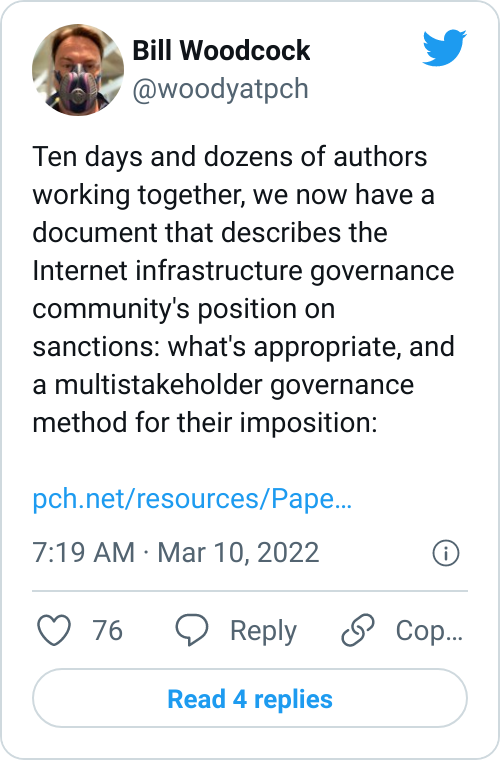
Sanctioning Governments on the Internet
What a strange article title to type:
Sanctioning Governments on the Internet.
What does that even mean?
Who would decide?
Who would implement the decision?
To say nothing of the consequences of trying to impose an Internet Sanction on a government or a country.
The internet as we know it is a quirky beast.
It is called «inter-net» because it is formed as the interconnection of independent networks plus a healthy dose of human capital (and independent streams of monetary capital), reliance on openly-published and open-ended standards, interpersonal trust, and—quite frankly—quite a bit of luck.
You might think of «the internet» as one big thing, but in reality it is many smaller things hooked together by common agreement.
The internet connection at my house comes from an Internet Service Provider (ISP).
My ISP connects to one or more (likely many more than one) other ISPs and transit providers.
Through those interconnections, a message I’m typing here will be sent to a computer across town, across the country, and across the world.
It works like this because many decades ago, a bunch of people got together to agree on the methods and rules computers would use to communicate with each other.
A guiding philosophy was to make those methods and rules simple and easy to implement.
Another guiding principle was to build up layers of complexity that relied on the functionality of the layers below it.
At the bottom-most layer, the network equipment moves messages along a path from a sending computer to a receiving computer. That equipment doesn’t understand or care what was in the messages…it just knows how to get the message one hop closer to its destination.
On top of that is a set of rules (a «protocol») for ensuring all messages get from the sender to the receiver and describing how to retransmit if something is missing.
On top of that is a protocol for translating human-readable names into computer-understandable addresses.
On top of that, a protocol for requesting and receiving a file.
Then a specification for how to arrange text on a page.
Lastly, a web browser that understands that specification and knows how to ask the layer below it to retrieve an HTML file from a faraway server.
The network layer at the bottom doesn’t know the difference between an HTML file and a snippet of voice on a Zoom call, and the browser at the top doesn’t know how the file got to it.
It is the common agreement on the protocols and specifications across decades of work that put this page in front of your eyes.
So about those key components of the «inter-net»:
human capital
: coming to agreement takes time, and humans need to bring their priorities, their experiences, their knowledge, and their biases to the table to work to a common agreement.
monetary capital
: every network that is a part of the «inter-net» is paying for its piece to connect its users to is neighboring networks; there isn’t one singular …
Descubre más desde Hoy En Perspectiva
Suscríbete y recibe las últimas entradas en tu correo electrónico.